This is my second replay of the Battle of Königgrätz (1866) using the Bloody Big Battles ruleset by Chris Pringle. The scenario used is from Bloody Big European Battles scenario book also by Chris Pringle. Figure scale is one stand = 2500 men or 60 guns. Each turn is an hour. The scenario goes from 0800–1800 hours. I played this as a solo game.
Sadowa and Chlum are always Prussian objectives. Die rolls determine the other four Prussian objectives. For this game, the additional objectives are Ober Dohalitz, Popowitz Wald, Nedělišt, and Stěžer.
Scenario map posted here with permission from Chris Pringle.
The battlefield at 0800
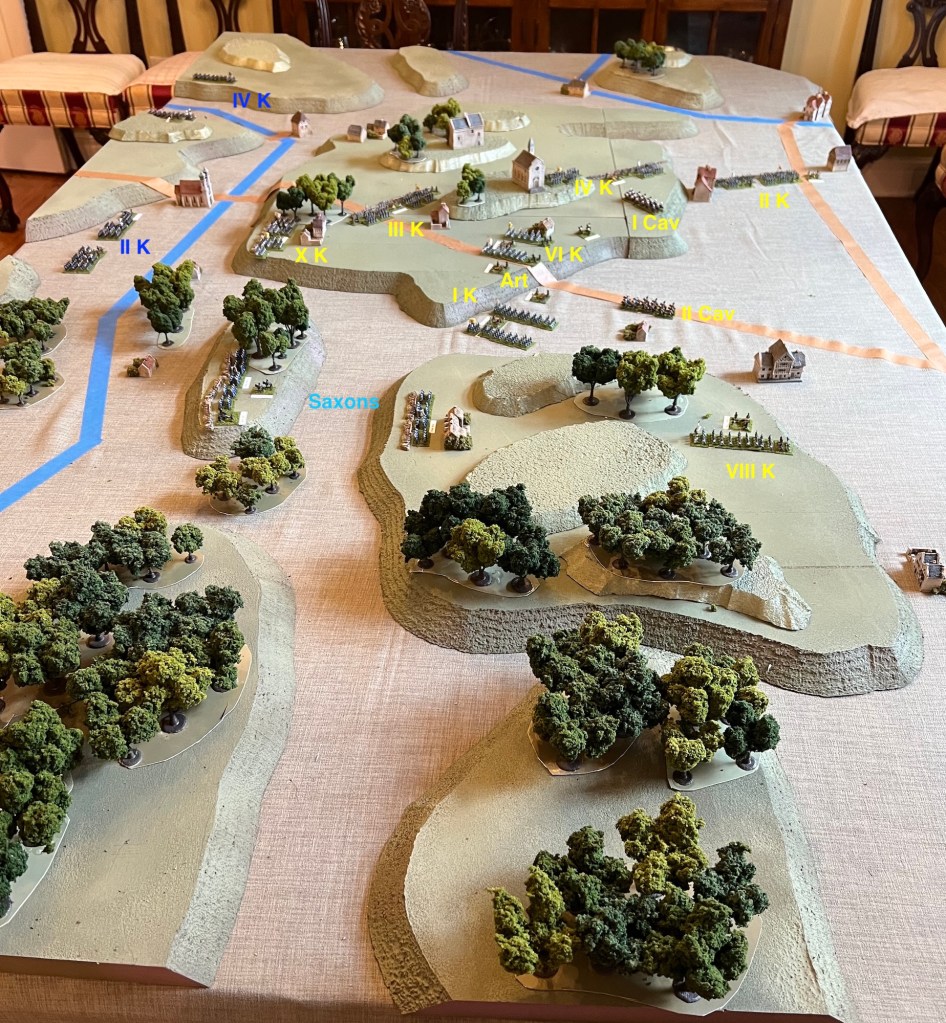
0800: The objectives focused the Prussian effort more towards the south. As Sadowa is pretty much a secure objective, the 1st Army will swing southeast and work with the Elbe Army to secure the southern objectives. The Elbe Army will pin the Saxons positioned in the south and attempt to turn their flank. Once it arrives, the 2nd Army will be used to pin the main Austrian force in the north. The Austrians will basically react to Prussian moves and look for opportunities for counterattacks.
The Prussian II Korps would attack to secure Ober Dohalitz while the IV Korps would move in support of II Korps and III Corps following, operating on a Line of Advance of Ober Dohalitz-Střezetitz-Problus. This would bypass the strong Austrian forces around Chlum and flank the Saxon position in the south. Elbe Army will cross the Bistritz and drive towards Pooblus, flanking the Saxons to the south. These moves will hopefully draw the Austrian northern forces west, exposing them to the later arriving 2nd Army.
The Prussian offensive got off to a mixed start. II Korps advanced within short range of the Austrian X Korps, but the corps artillery didn’t move. IV Korps had a mix of full and half moves, while the III Korps artillery moved, but the infantry didn’t (the 6th Division failed its roll, and the 5th Division behind it stayed in place).
Both the 3rd and 4th Divisions escaped any serious damage from the Austrian fire while the Austrian Brigades Mondi & Knebel were disrupted. In reaction, Benedek committed the I Korps to move forward to support X Korps. Prussian fire disrupted all four brigades in X Korps, while the Prussian 3rd Division was also disrupted. The Austrian reserve artillery limbered.
The situation around Ober Dohalitz at 0900.
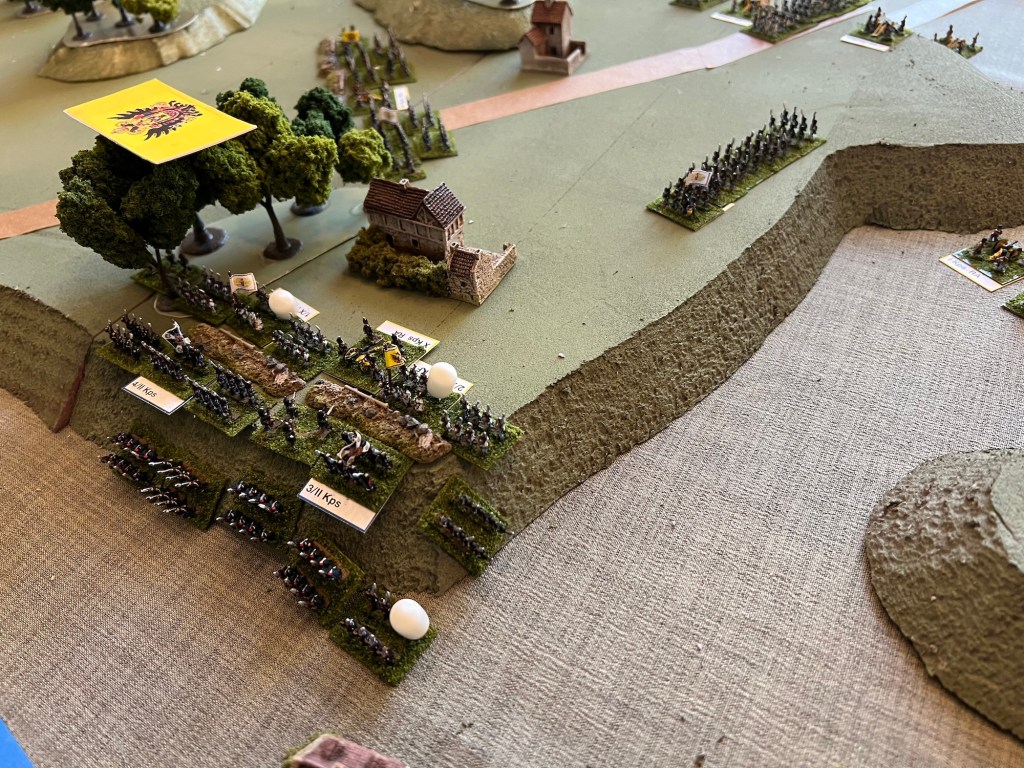
0900: The Prussian offensive continues to unfold slower than planned. The IV Corps again experience a mix of full and half moves. III Korps finally moves forward, along with all the Prussian corps artillery. II Korps successfully charges into the Austrian X Korps. The Elbe Army… doesn’t move.
4th Division trades fires with Brigades Mondi & Knebel then takes the position with the Austrian brigades retreating, both sides disrupted. 3rd Division hammers Brigades Grivicic & Wimplffen with needlegun fire, removing a stand and keeping the unit disrupted. The assault is a difference of four, which removes another stand destroying the unit. The Prussians carry the rifle pits. The Austrian I Korps moved forward and occupied Ober Dohalitz. No other Austrian units are committed. The Prussian fires miss, but Brigades Poschahcher & Piret hit the 3rd Division, removing the skirmishers.
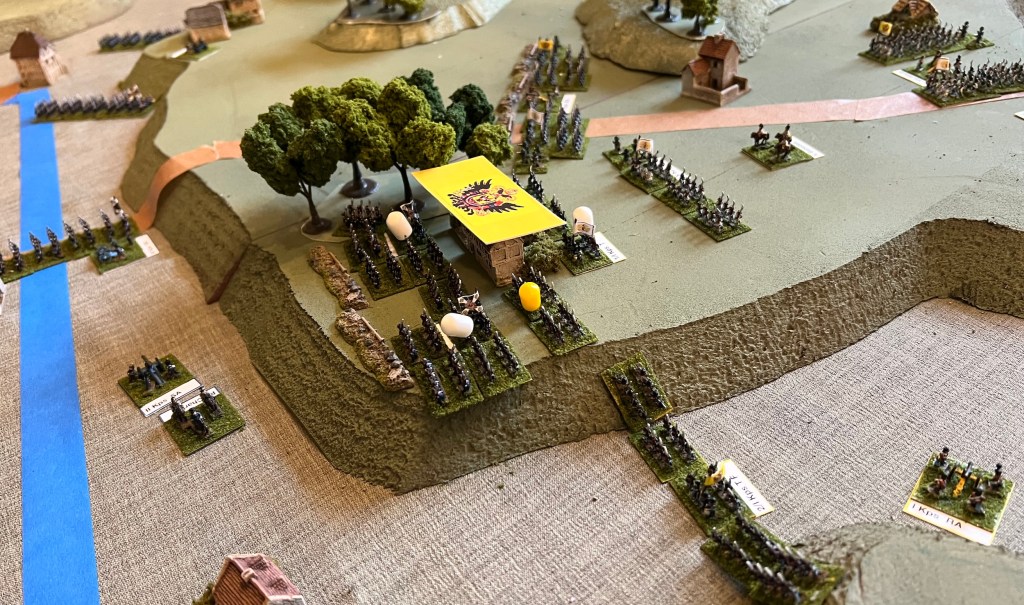
1000: The Prussians again are bedeviled by poor movement rolls. The attack against Ober Dohalitz falls apart as the 4th Division doesn’t advance, so the 3rd Division attacks alone. 4th Division can’t even support by fire. 3rd Division is disrupted by the Austria fire but manages to kill an Austria stand in return, going Low on Ammo at the same time. The division does carry the village, but only pushes Brigades Poschahcher & Piret back with both disrupted.
Given the success of the Prussian effort against Ober Dohalitz, Brigades Leiningen & Ringelsheim of the I Korps fall back to conform with Brigades Poschahcher & Piret. This turns out to be premature, as X Korps decides to redeem its honor. Brigades Mondi & Knebel surge forward and attack the 3rd Division in the village. Surprised, the needleguns fail to stop the attackers and the Austrian fire inflicts another loss on the division rendering it spent. The hand-to-hand is vicious, but the Austrians succeed in throwing the Prussians out and once agin control the village.
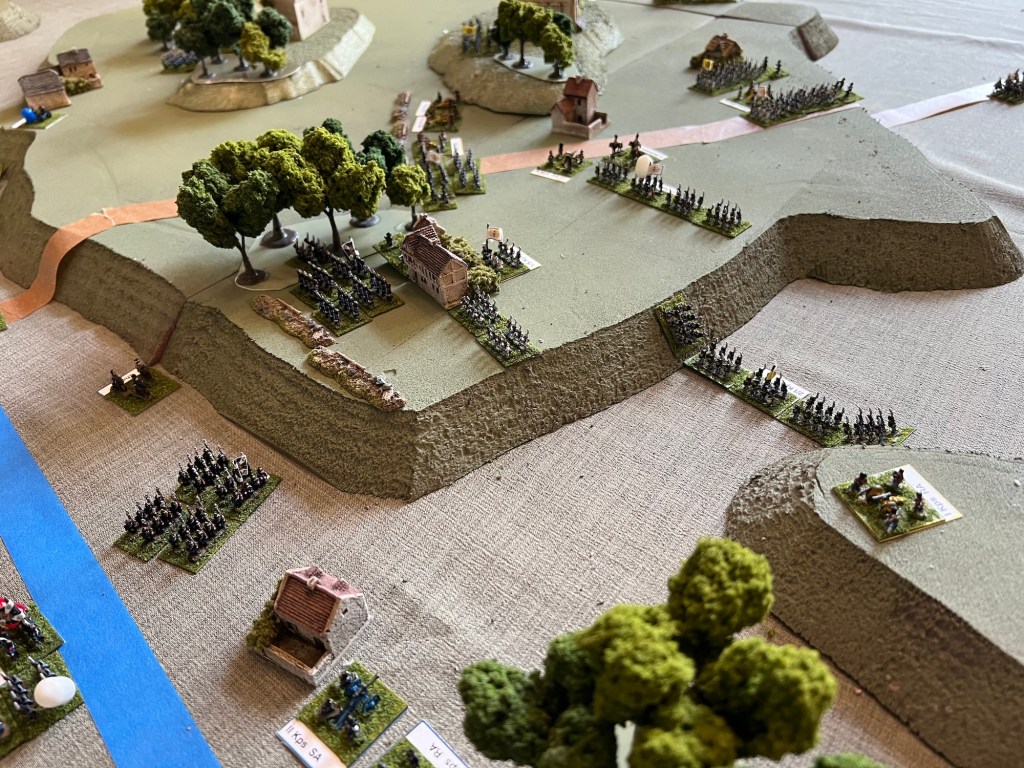
Saxon Crown Prince Albert is wondering whether he is being left out on a limb as he sees the Elbe Army beginning to work around his flank. Looking behind him, he see no sign of movement of any reinforcements. Back up by Chlum, Benedek is wondering the same thing. Seeing the seriousness of the Prussian effort to the south, he ordered the VIII Korps to move to Albert’s support. He too doesn’t see any movement. Clearly another order is needed.
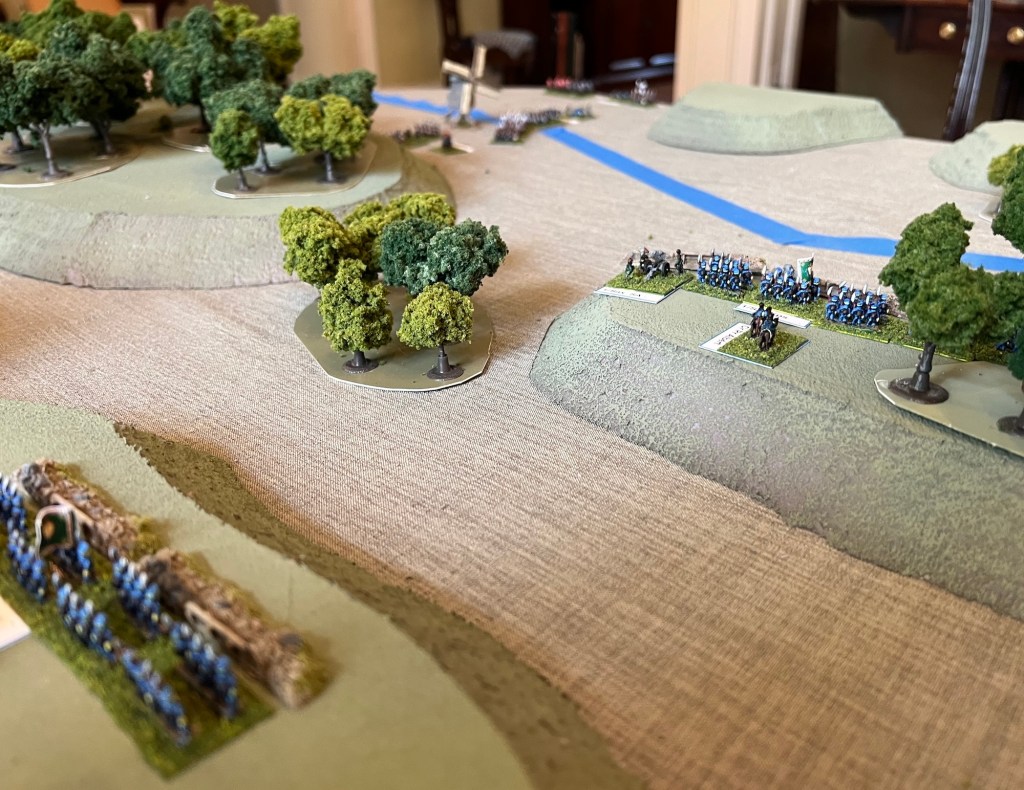
1100: The first crisis of battle is upon the Austrians. The 5th Division of the Prussian III Korps wheeled and then charged the Austrian troops in Ober Dohalitz. The 4th Division of the II Korps joined the attack and two fresh divisions slammed into the exhausted Brigades Mondi & Knebel. It was too much and the Austrian brigades crumpled and fled (7+ result). Carried away by their success the Prussian divisions leave the village and rolled across the top of the hill and into the also tired Brigades Poschahcher & Piret. While not a massive blow, the two Austrian brigades were forced to retreat after losing a stand and becoming spent. A hole was now open in the Austrian defense south of Chlum.
One positive aspect of the situation for Benedek was that the breakthrough happened directly in front of his last infantry reserve, the VI Korps. Quickly issuing orders, he instructed the corps to deploy and charge. But the Austrian Army wasn’t known for its celerity in actions, Brigades Rosenzwieg and Jonak performed the evolution as if they were on a parade field before the Emperor, slow and precise (rolled a half move). The movement also now blocked Brigades Waldstätten & Hertwegh and the corps would never be able to act in time.
With the failure of the IV Korps to attack, Benedek takes a bold action. The Prussian delays in getting their forces in action meant that the two divisions are unsupported. The elements of the I and III Korps on the flanks of the penetration are not threatened by any nearby Prussian units. He ordered the brigades on the right and left to wheel and charge the flanks of the two Prussian divisions. If they could gain a decisive success, it would change the bleak situation staring at the army. Brigades Leiningen & Ringelsheim of the I Korps and Brigades Appiano & Benedek of the III Korps quickly executed their orders. Only the two Prussian artillery units able to fire on the flank of the I Korps attack could wreck the plan. After the smoke had cleared, Brigades Leiningen & Ringelsheim emerged unchecked by the Prussian fire (was on the 16 column and rolled a 4). The two attacks hit the Prussian units and they grudgingly gave way after a stiff fight (one attack had a +3, the other a +4, but both die rolls were one less for the Austrians, so only +3 results). While the gap was closed, the threat wasn’t eliminated and Benedek had committed his last reserve.
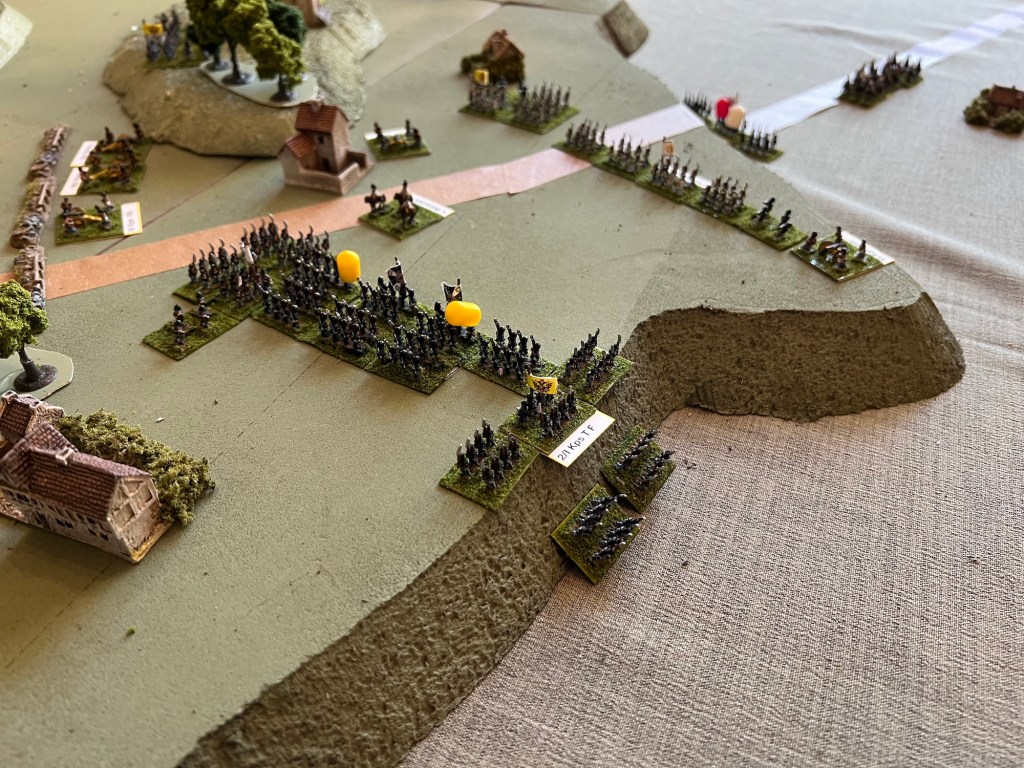
In the south, the VIII Korps finally moved up to support the Saxons but that situation was still dangerous. The Elbe Army finally began to put some pressure of the Saxons. The 14th Division had moved south of the Saxon position while the 15th and 16th Divisions began to pin the Saxons in place. The Saxon artillery scores a hit on a Prussian artillery unit, making the artillery duel 2 to 0 in favor of the Austrians. The Prussian artillery has been a non-player so far (some really bad rolls).
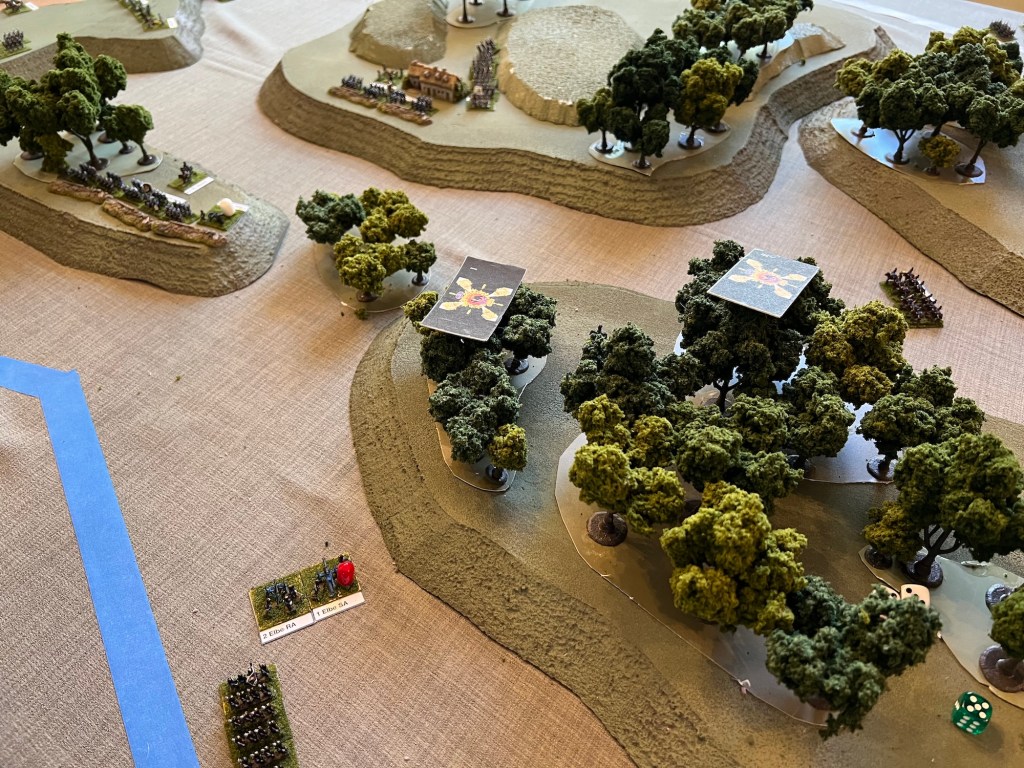
n the north, the 2nd Army was also now appearing in strength. The advancing 2nd Army would be a challenge to stop, especially with all the reserves except for two cavalry units committed.

1200: As Benedek finished with one crisis, he is now faced with another.
The Prussian 4th and 5th Divisions again move out of Ober Dohalitz to engage in a firefight with the four Austrian brigades. This doesn’t work so well for the Prussians as both divisions are disrupted, with only the two brigades of the I Korps are likewise disrupted. However this move isolates the I Korps artillery on the hill south of Ober Dohalitz which is charged by the 6th Division of the III Korps and by the Cavalry Korps in the flank. Only a few elements of the Saxon 1st Division can support, and the musket fire at long range has little impact. The canister rounds from the rifle guns are not enough to stop the 6th Division, and the supporting fire from the Prussian artillery smother the Austrian guns. The cavalry easily sweeps over the few surviving artillerists and continues into the flank of Brigades Leiningen & Ringelsheim. What seems like an easy victory isn’t and the Austrian infantrymen mange to hold off the cavalry long enough to execute a hasty withdrawal. The result is that the VIII and Saxon Korps are now well separated from the bulk of the army and the Prussians have opened a route to the Austrian rear.
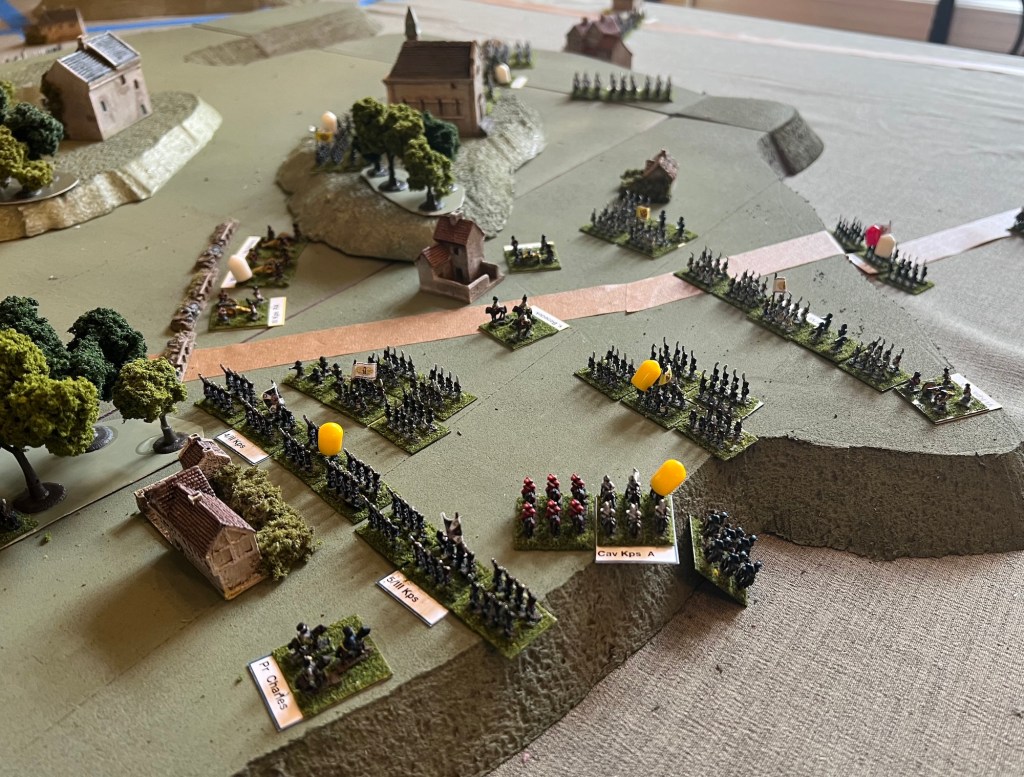
Benedek sees that the Prussian IV Korps remains at arms length, so leaves the batteries to face it alone. He extents the frontage of the III Korps brigades to link with the batteries and present a sold front. Brigades Appiano & Benedek of that corps extent into line and accept a fire fight with the Prussian 4th Division. It would appears to an unfair fight but the soldiers of the 4th Division are shaken and their fire goes wild, while the men of the Austrian brigades remain cool under fire and continue to attrit the Prussian ranks. The 4th Division is now spent. The musketry skill of the Austrian I Korps is mixed with the Prussian cavalry escaping serious harm but the 6th Division does take casualties.
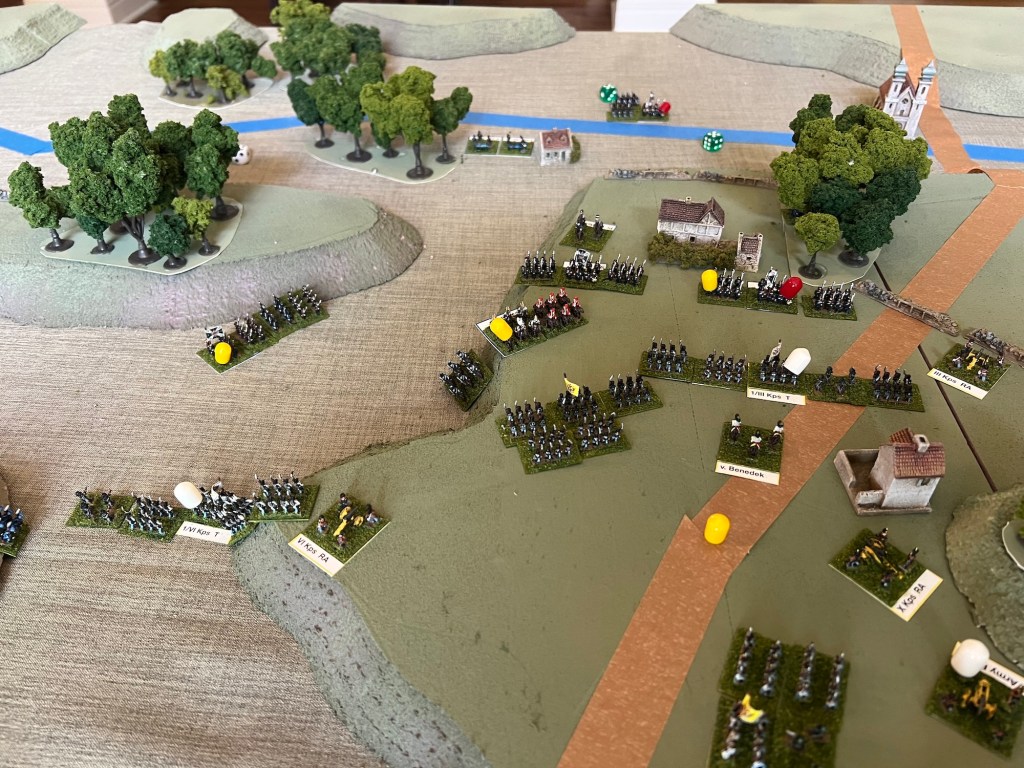
Just north of the fighting around Ober Dohalitz the Prussian IV Korps began to move forward to pin the Austrian center around Chlum. The Austrian artillery and infantrymen of the IV Korps proved their skill and the men of the Prussian 7th Division began to take casualties even when protected in the town of Maslowěd. The Prussian return fire doesn’t phase the Austrians.
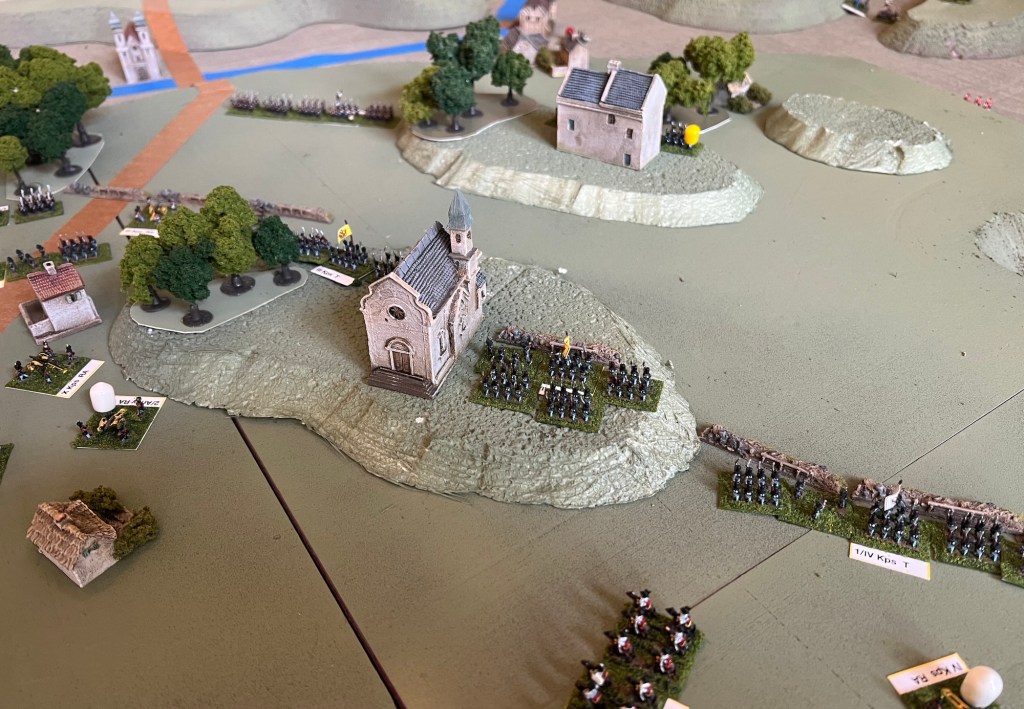
The situation turns for the worst for the Saxons. After entering the woods to the south of the Saxon position, the Prussian 16th Division suddenly rushes from cover and closed within needle gun range of the Saxon artillery. Albert had been debating whether to move the Saxon 2nd Division forward or withdrawal the 1st Division back, but waited a hour too long to make that decision. Now the Saxon artillerists feel the power of the needleguns at close range. Taking casualties, Albert quickly decides to pull the 1st Division and artillery back to align with the 2nd Division. While the 1st Division successfully disengages, the artillerymen were shot down as they attempted to move the guns. Albert is able to deploy the 1st Division north of the 2nd, while the VIII Korps takes up positions to the south.
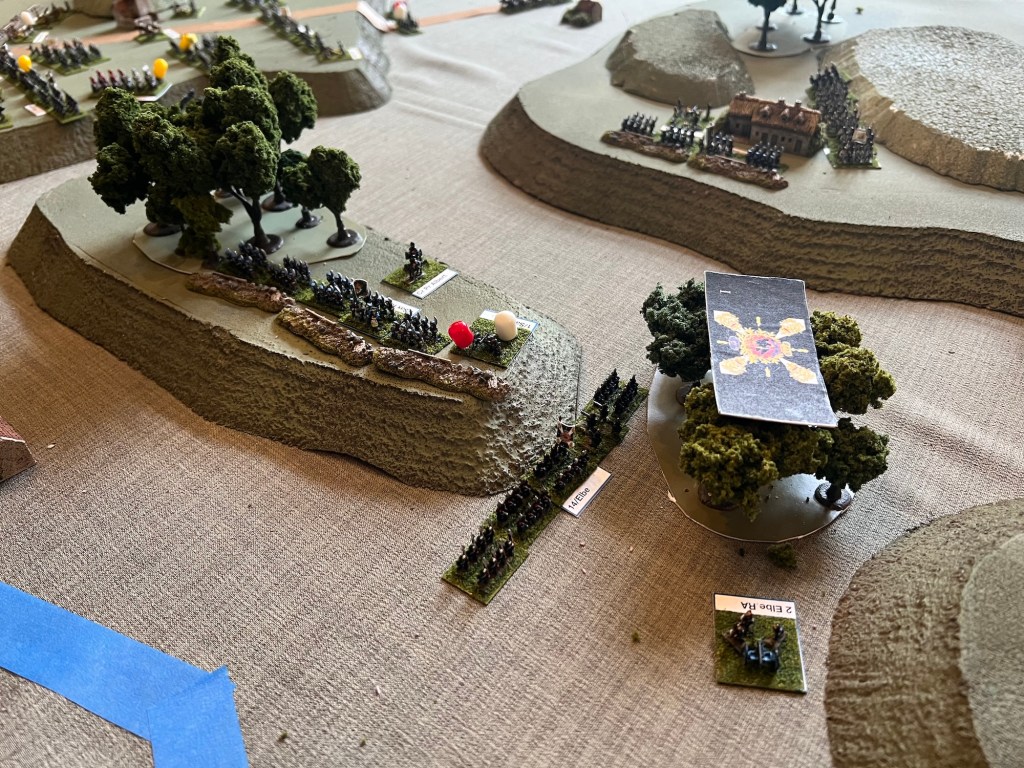
The seriousness of the advancing 2nd Army worries Benedek. As the IV Korps becomes increasingly engaged to the west, only the II Korps remains unengaged. Facing it appears to be at least three Prussian Korps. Benedek decides to shift his only reserve, the two cavalry units in positions to support that lone corps. Mirroring what has been happened all day long, the cavalry is very slow to respond.
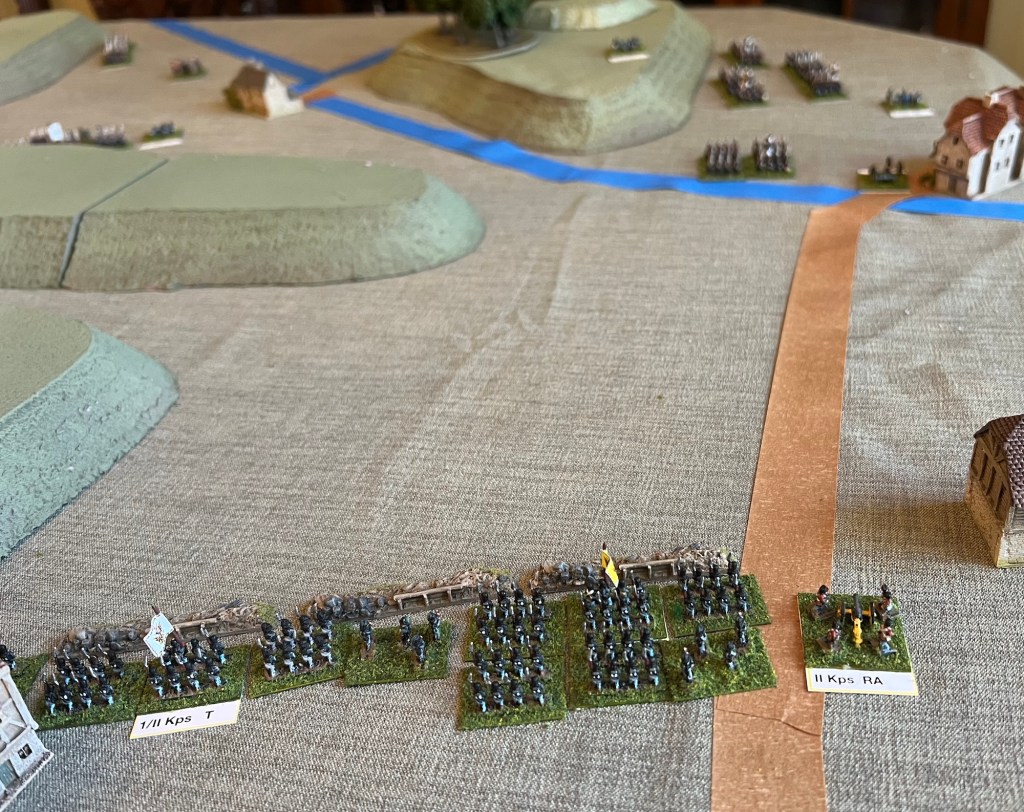
1300: The Prussian advance from the north is moving ahead, but units are moving slower than intended. The Austrian II Korps can only watch as their corps artillery has been silenced by the Prussian guns.
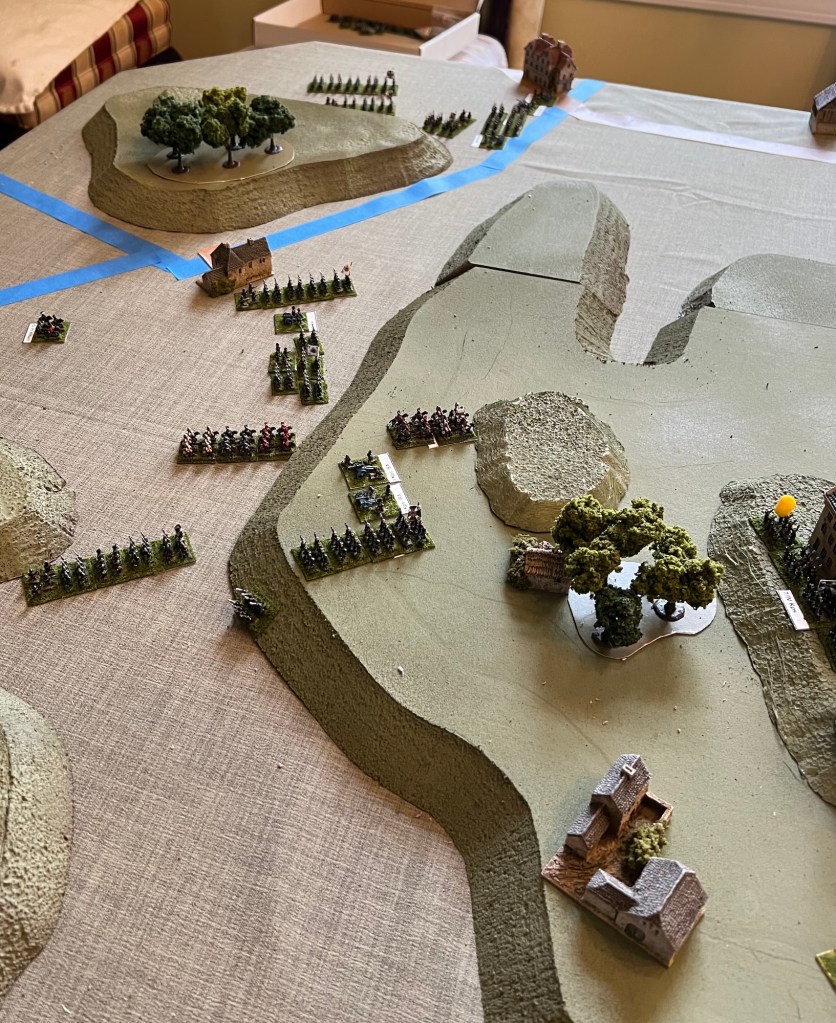
The Prussian 7th Division (IV Korps) holds it position around Maslowěd as the 8th Division charges the unsupported Austrian guns. Amazingly the Prussians survive the artillery fire and rush into the position, but the fire did slow the attack down enough for the Austrian gunners to limber their pieces and retreat.
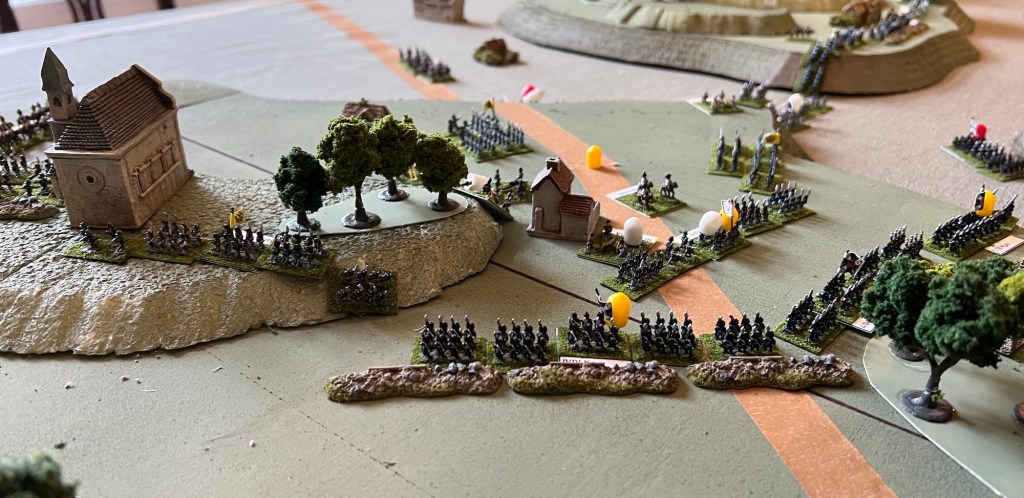
The Prussians consolidate their position between Ober Dohalitz and Chlum as they await promising developments to the their north and south. The firefight exchange once again goes against them with both III Korps Divisions suffering and the 6th Division finally breaking. The Prussian 1st Army is running out of stream.
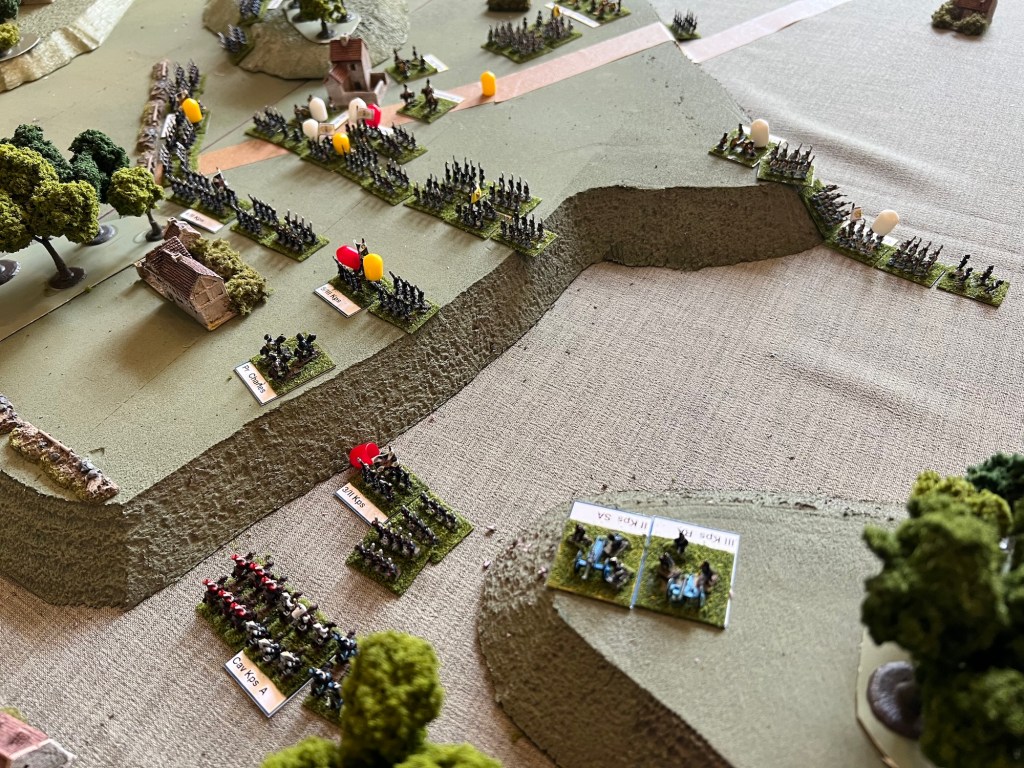
The Elbe Army also takes time to develop their position. Ideally the 14th Division would swing northeast to flank the Austrian VIII Korps while the 15th Division pins it in-place. The problem is the Saxon cavalry holding a position that would flank the 14th Division as it moved. The solution was the Elbe Army cavalry, but it had yet to move until now so is badly out of position. The 14th Division began to advance against the Saxon cavalry until its own cavalry can come up. The Elbe artillery does strike, hitting the Austrian VIII Korps artillery and forcing it to retire.
1400: A mixed hour for the Prussians. The 2nd Army is still trying to get into position. Units are still coming up slowly.
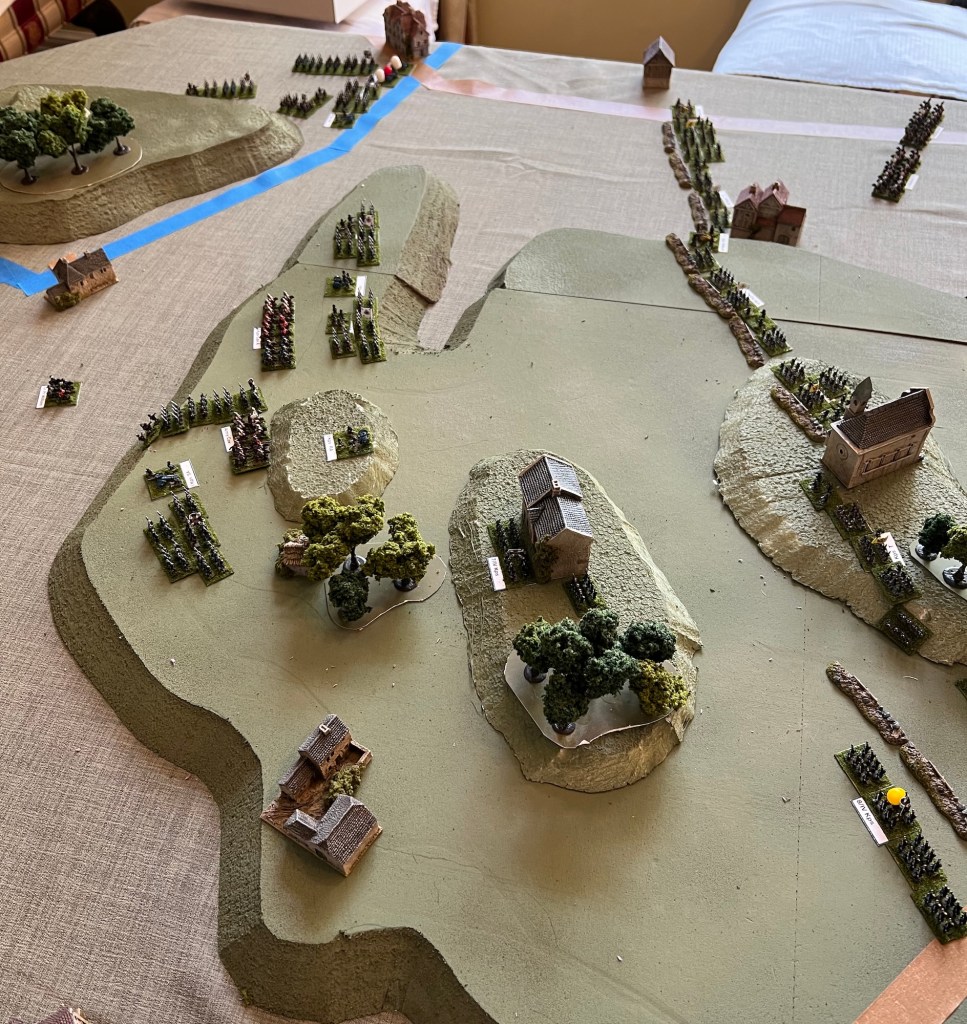
The 8th and 4th Divisions step out and attack Brigades Appiano & Benedek of III Korps, supported by Brigades Poschahcher & Piret. The defensive fire did no damage to the attackers and the offensive fire had no effect as well (20 column and rolled a 3). A bad assault roll for the Prussians and a retreat 3”. These two Austrian units have been in the thick of the fighting and are still holding on. However Brigades Leiningen & Ringelsheim are hit by the 3rd and 5th Divisions, losing its skirmishers. Brigades Rosenzwieg and Jonak from VI Korps is also hit. A possible charge by Brigades Waldstätten & Hertwegh also of VI Korps is thwarted by a delay in receiving their new orders, and the two brigades only move up inline with Brigades Rosenzwieg and Jonak. The 1st Army cavalry still remains in place. Frederick Charles is getting a bit perturbed at them.
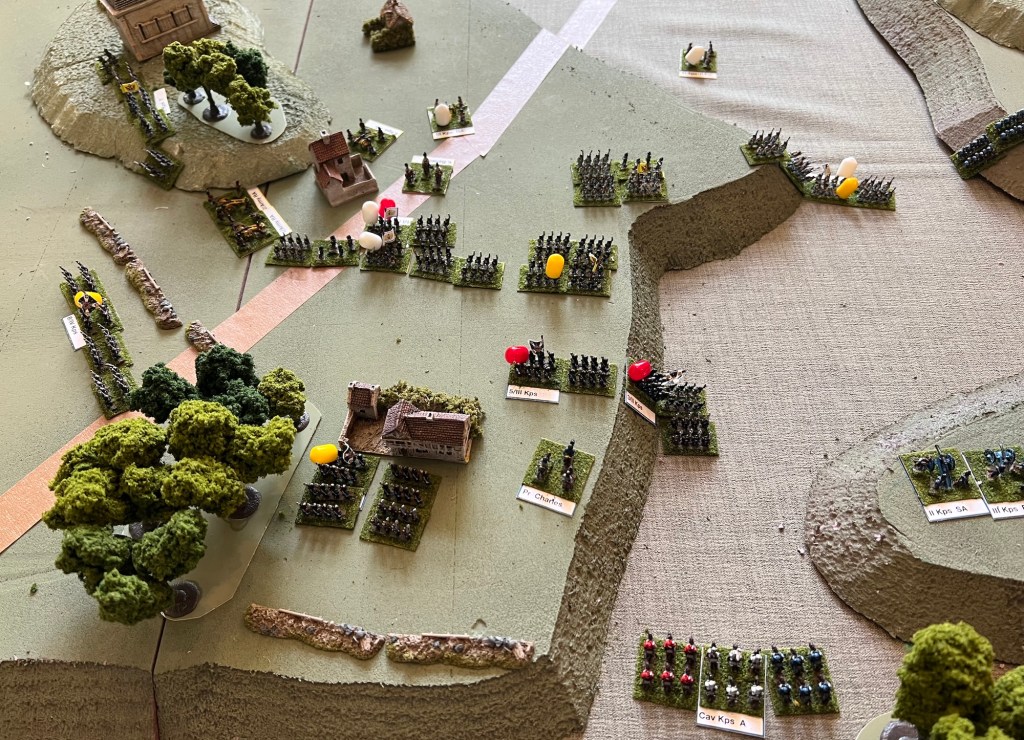
The Elbe cavalry charges the Saxon cavalry and expects the 14th Divisions to support. No such luck as the 14th Division does’t move. Slight advantage to the Prussians but the Saxons hold and force the Prussians to retreat. Seeing an opportunity the Saxons now charge the Prussian cavalry but enter into the long range of the 14th Divisions. All the Prussian infantrymen’s frustrations from the delays is released onto the Saxon cavalry and the division is shattered (actually rolled a 12). The 14th Division is now free to turn the southern flank.
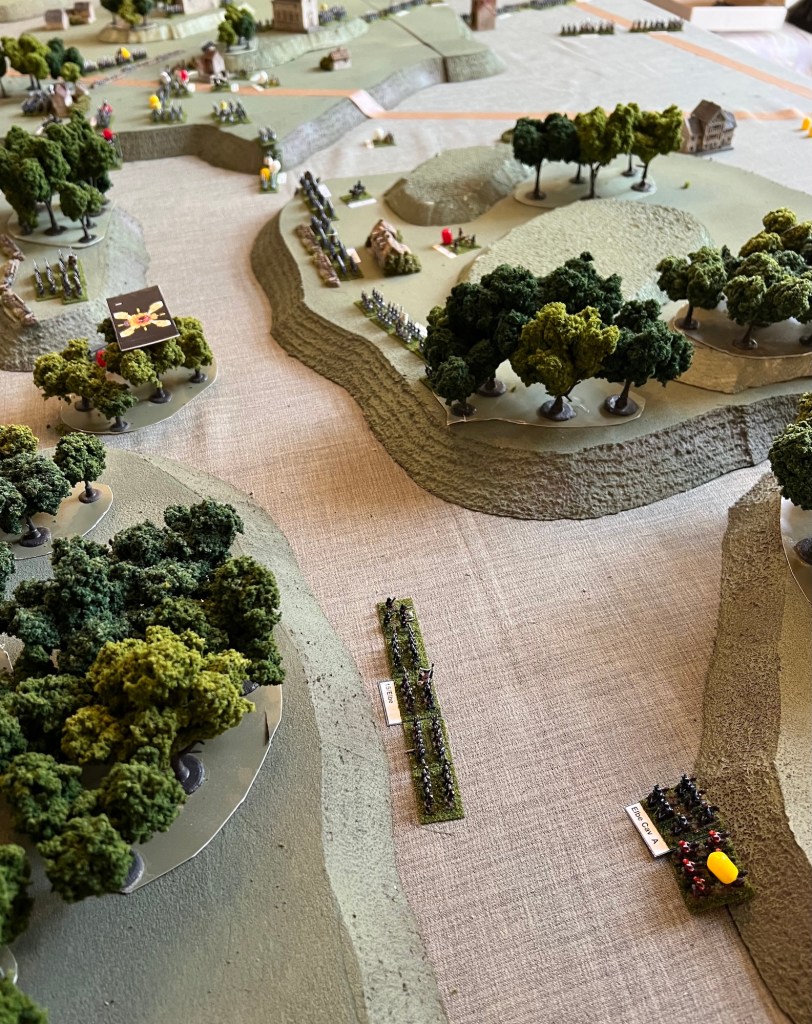
1500: Frustration is the name of the game for Crown Prince Frederick William. Both the V and VI Korps have been stationary for two hours. Not even a twitch among their ranks.
Rather than wait to make a coordinated assault on the Austrian lines, he looks skyward and yells Mein Gott! Die königliche Garde greift an! But even this frustrates him as only the 2nd Guard Division receives the order. Searching quickly, he espies the I Korps cavalry and the Army Cavalry to the right of the Guard Korps. Kavallerie vorwärts! The cavalry quickly responds and joins the 2nd Guards in the charge. The sight must have unnerved the men of Brigades Poeckh & Joesph and their supporting artillery as their volleys are ragged. The Guards return fire as they charge creating casualties and chaos amongst the Austrian ranks. The guards and horse then sweep over the Austrian force causing more casualties and forcing them to flee. The cavalrymen seeing what is a most desirable sight, pursue, sabring more and destroying what was left of the two brigades. Benedek can only stare as he sees a gapping hole appear in his lines east of Chlum.
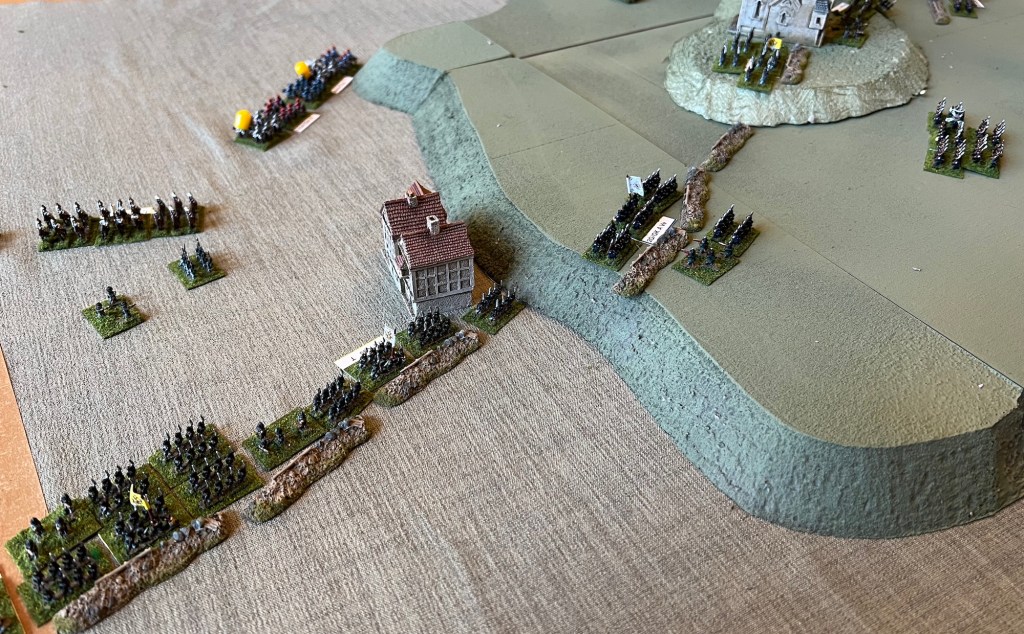
Once again the 4th Divisions attacks out of Ober Dohalitz and once again Brigades Appiano & Benedek force them back into the village. The Prussian Cavalry Korps again doesn’t charge and sits passively.
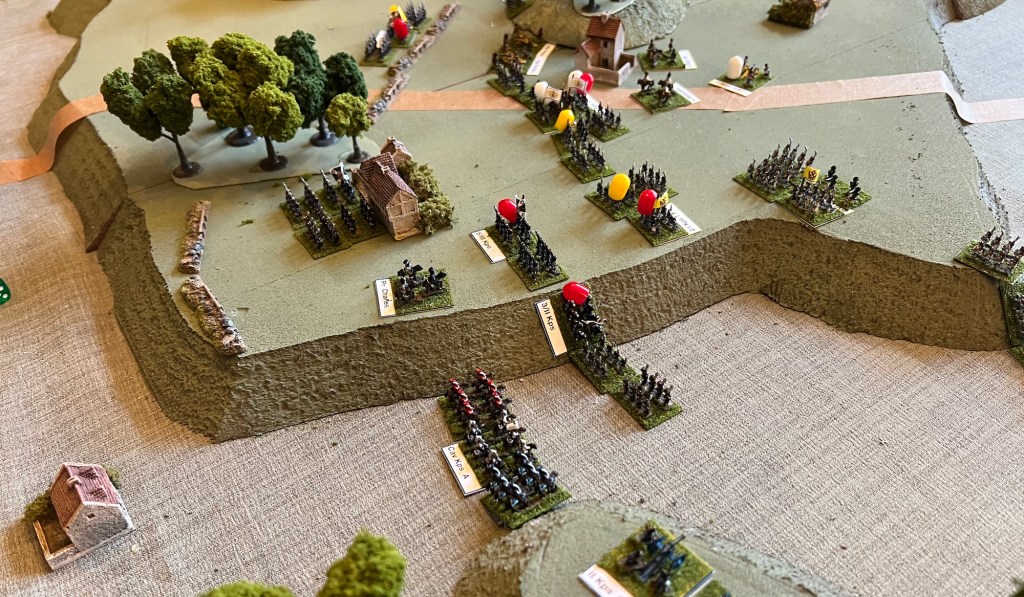
The 14th Divisions turns into the woods and unto the southern flank of the Austrian VIII Korps threatening the Saxon line. The Elbe cavalry is still recovering from their pervious combat and doesn’t move.
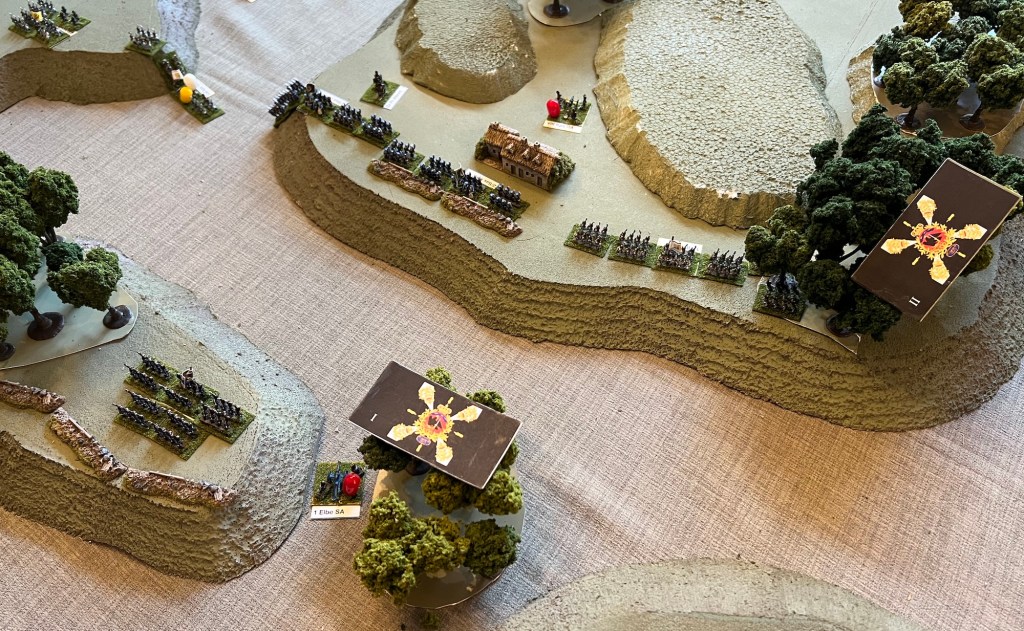
Benedek can’t exploit the success in the center as the disaster to IV Korps and the threatening moves in the south against the Saxons means the battle is lost. His only remaining option is to save the army. At hand are the two cavalry units, the 1st & 2 Divisions and the 3rd & 4th Divisions. These will need to keep a route of retreat open for the Austrian center. Reaching into his pocket, Benedek pulls out his very last reserve: two fresh dice.
Gambling on the cavalry, he is partially successful. The 1st & 2nd Divisions wheel and charge the Prussian I Korps Cavalry into their flank. But the 3rd & 4th Divisions don’t receive the new orders in time and continue to support the II Korps. Still the odds are good for the Austrian horsemen, but the charge is indecisive. The I Korps Cavalry is forced back but not broken. The Prussian Army Cavalry remains unengaged.

All goes well in the Austrian center. All the batteries are able to limber and move rearward while all the infantry brigades fall back and form a new defensive line. The firefight only slightly favors the Austrians, but not enough to make a noticeable difference. The two artillery units that had previously withdrawn to resupply and reorganize are ordered to move to the gap in the IV Korps lines to cover the retreat but only partially execute the order. The gap is still a danger.
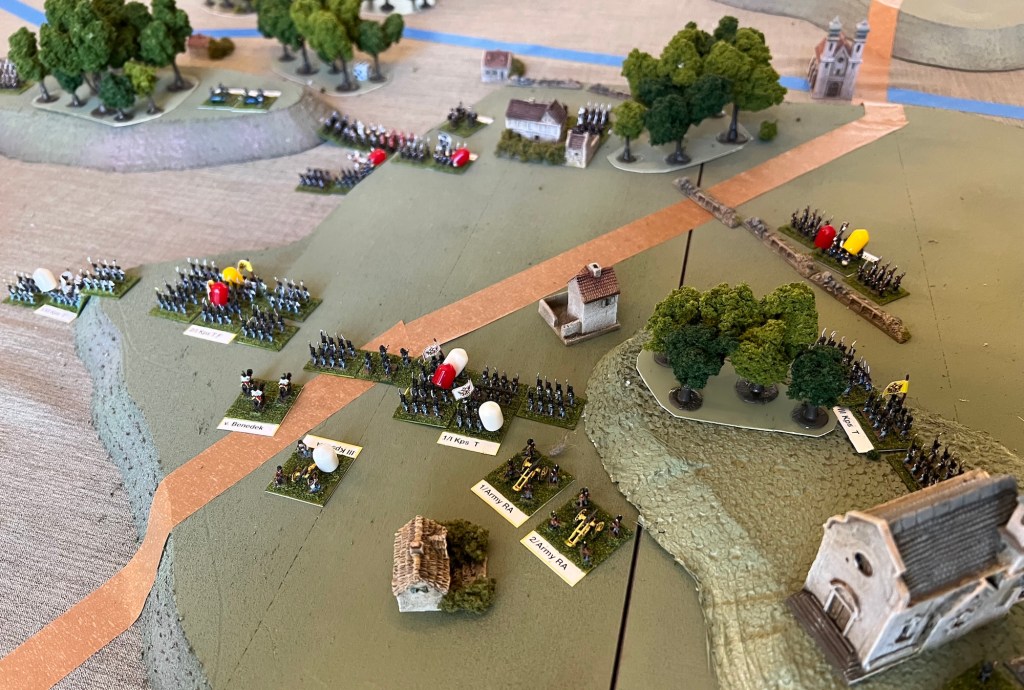
To the east, Brigades Thom & Henriquez quickly face to their left flank and occupy the village of Nedělišt to cover the left flank of the II Korps. The 2nd Guard fire only causes a few casualties, while the Austrian return fire drops many of the Guard skirmishers. The II Korps can only wait for the enviable Prussian attack of that least two corps while keeping a line of retreat open for the army.
Things don’t go well in the south. VIII Korps delays in turning to meet the threat from the south and remains dangerously exposed. The artillery too fails to reposition. Albert is hoping that the Prussian advance is slowed enough to give him time to execute his withdrawal.
1600: The Prussians finally gets most of their units moving but none of their attacks are a smashing success. This provides the Austrians a bit of breathing room.
The lead corps in the north, V Korps again fails to move. The VI Korps does advance, but only half moves. As it was behind V Korps, this part of the Prussian line barely moved forward.
2nd Guards turns and charges its tormentor in Nedělišt. The exchange of fire is indecisive and the guards rush into the village. The Austrians are forced out, but remain in fighting form and still protect the flank of II Korps.
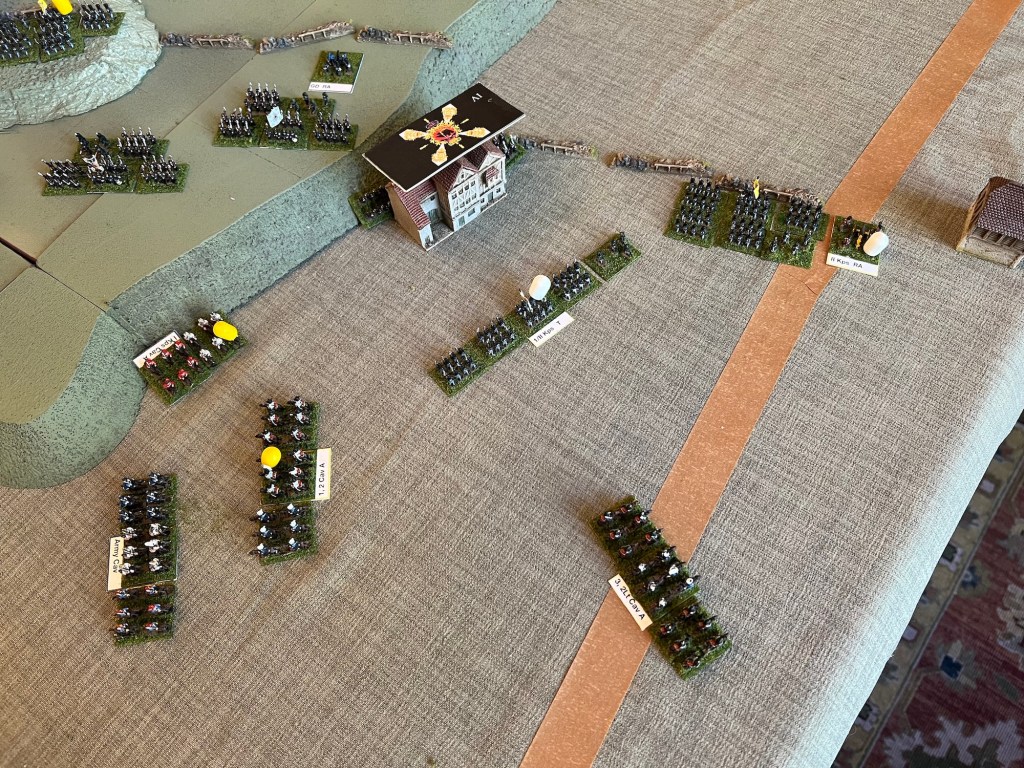
1st Guards and 1st Division move into the gap, but the attack by 2nd Division against Brigades Brandenstein & Fleischhacker of IV Korps is stopped with excellent rifle fire. 8th Division moves towards Lipa but undergoes rifle fire and loses more men. 4th and 5th Division again attack Brigades Appiano & Benedek. 4th charges home but the 5th is stopped by rifle fire. The Austrians are forced to give ground but still form a sold line in front of the Prussians. The Prussian Cavalry Korps finally launches its charge but is stopped by rifle fire.
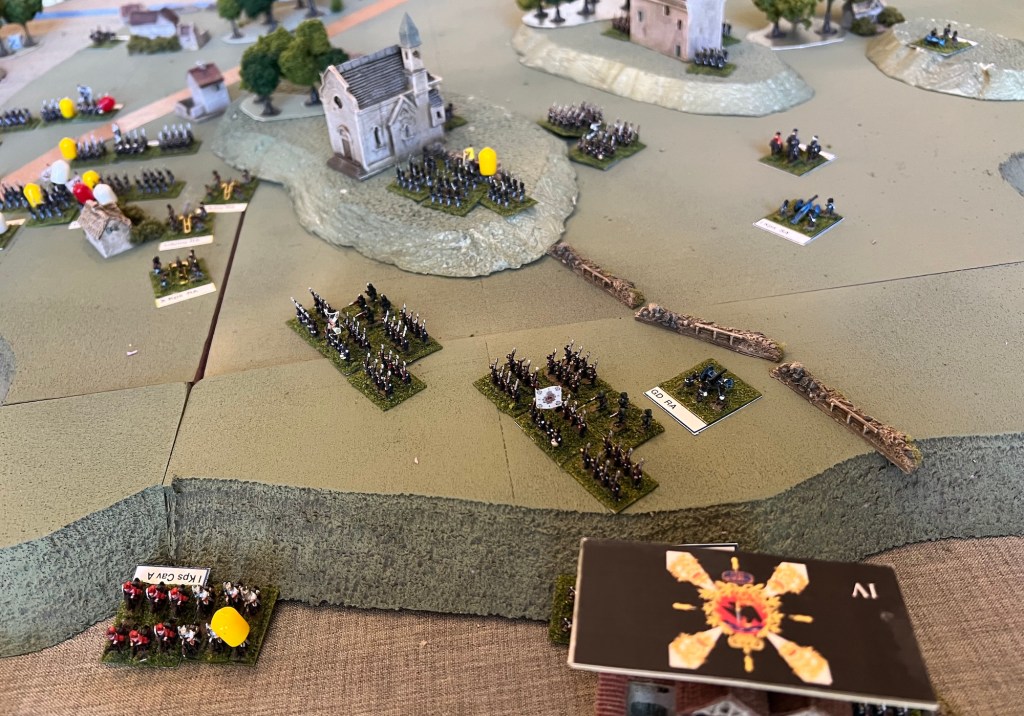
The Austrian 1st & 2nd Divisions charged the Prussian Army Cavalry. It was an even match and they both fought each other to the death (I roll doubles twice in a row).
In the south the 14th Division charges into the flank of the VIII Korps causing some losses and pushing the corps back, but nothing decisive. The Elbe Cavalry moves and occupies Stěžer. This is the first time I have intentionally made a move to occupy an objective.
The Austrians have few options. The lethargic movement of the Prussian V and VI Korps gives them some time to react to the Prussian breakthrough. Four artillery units unlimber and fire at close to medium range into the flank of the 1st Division. It is unknown whether the hasty movement or the general sense of fear impacted the gunners, but the 1st Division is only slowed and takes few casualties (on the 25 column and rolled a 3). Brigades Thom & Henriquez charge back into Nedělišt to secure II Korps flank, but the Prussian guards are too well ensconced. Rapid needle gun fire first stops then drives back the two brigades in disarray. Nedělišt remains firmly in Prussian hands.
In the center, Brigades Appiano & Benedek are once again order to charge but the brigades falters and remain in-place. The remaining brigades hold their ground to protect the rear of the artillery line.
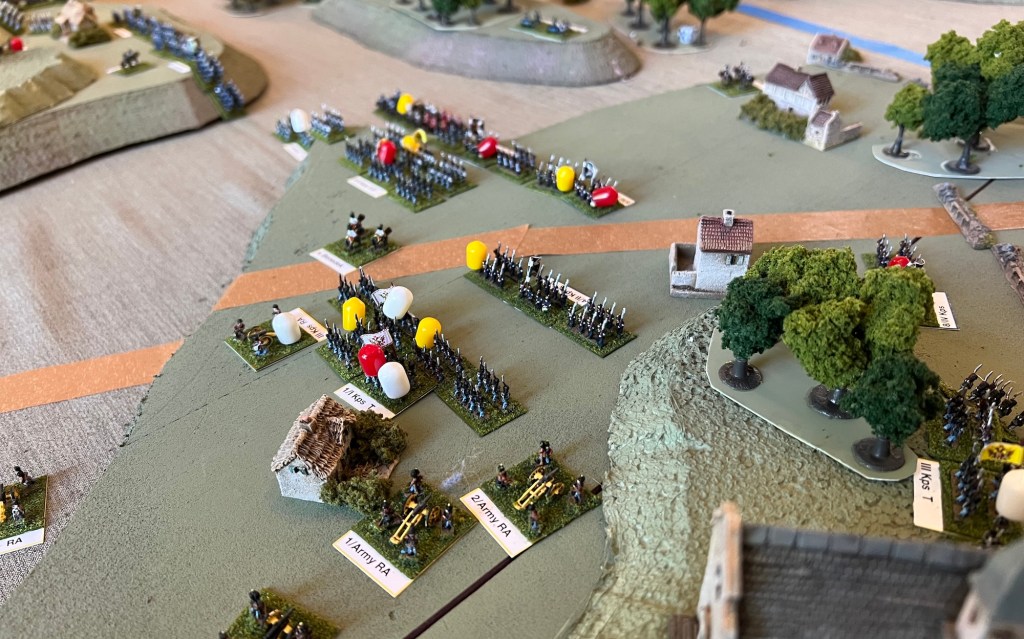
In the south, 1st Saxon Divisions begins to disengage, but the 2nd Division hesitates and remains in the rifle pits. In desperation, Albert orders the VIII Korps to charge towards the 14th Division to give time for the 2nd Division to move. Unfortunately, the needleguns of the Prussian division this time prove deadly and the VIII Korps recoils back with many causalities. The Saxon corps is now in deep peril.
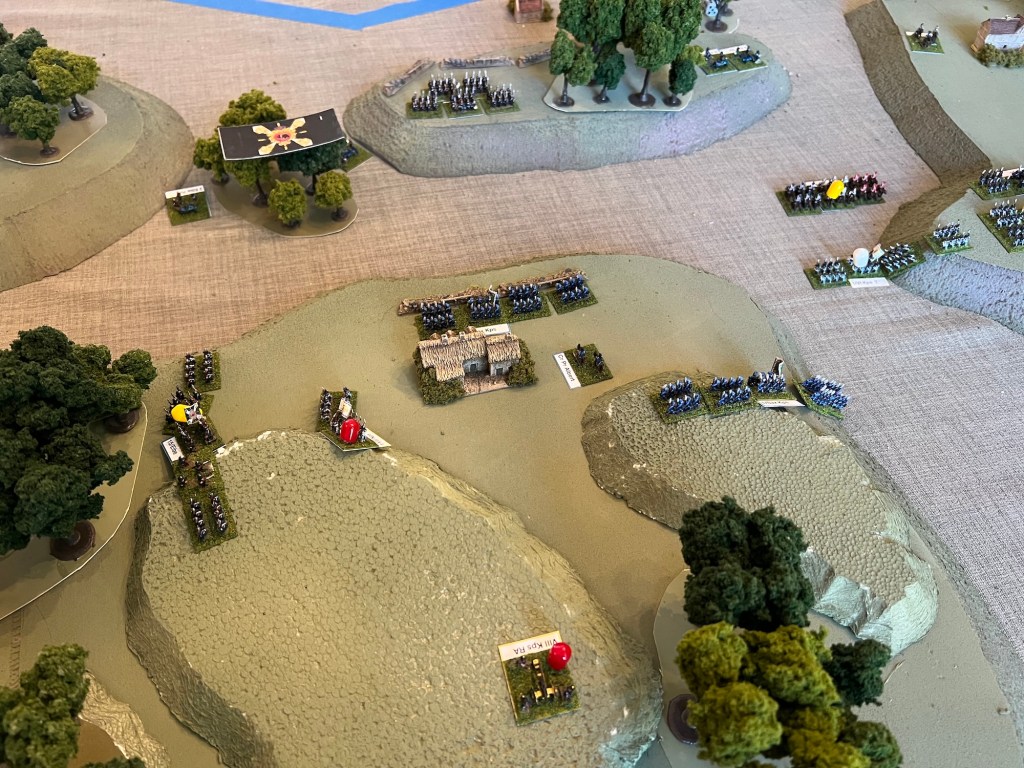
1700: The scenario states nine turns (0800-1800), but going to 1800 is ten turns. If the scenario is nine turns, the Prussians won with five objectives. If the scenario was meant to go to 1800, one more turn needs to be played.
The Prussian V and VI finally got moving with 10th and 11th Division moving to provide fire support (only rolled half moves) while 9th Division charged home. 12th Division didn’t move. The defending Brigades Saffen & Wüttemburg only cause slight damage to the approaching Prussian, but in-turn was disrupted by the Prussian fire. However the brigades did throw back the Prussian attack and held their position, precarious as it was.
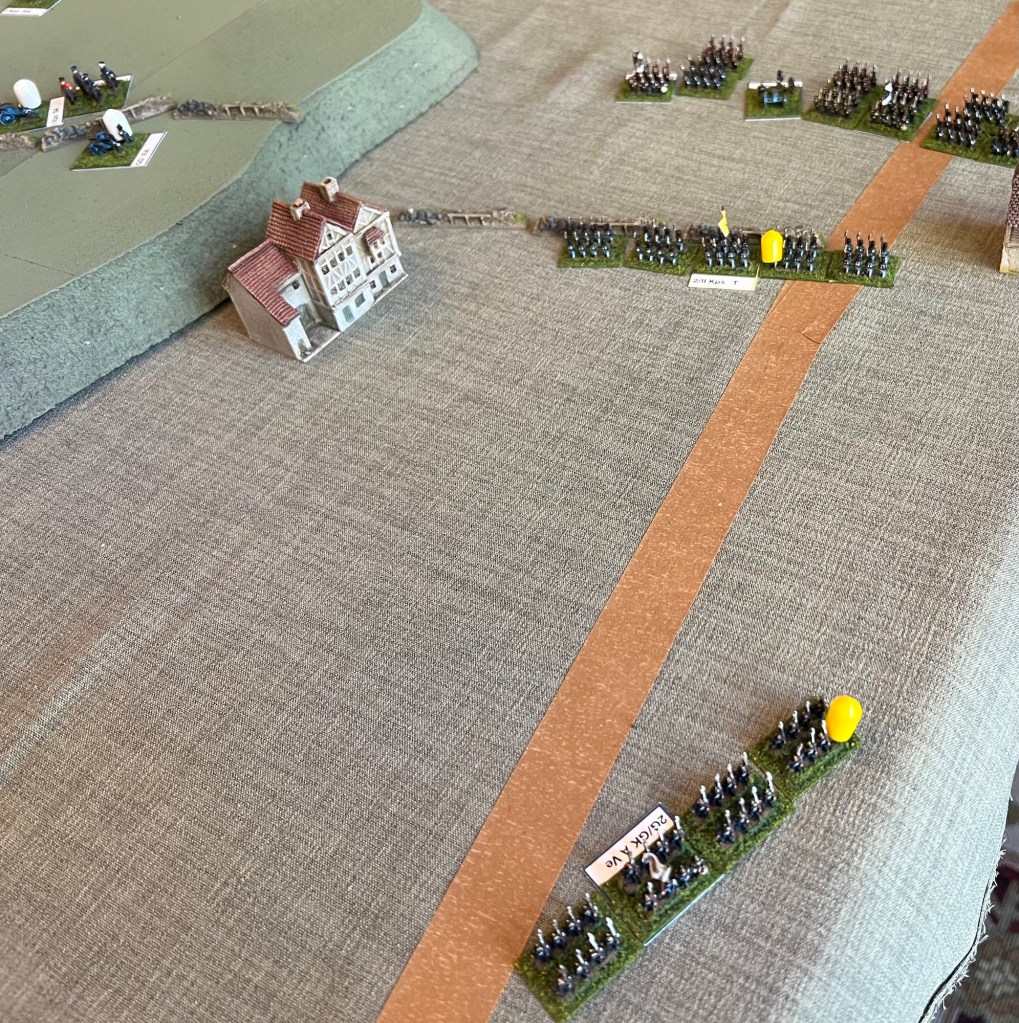
The 2nd Guards charged out of Nedělišt and towards to disorganized Austrian cavalry and guns. Both chose to evade which took them off the table. (I debated whether to let the cavalry stand and be attacked in the flank in the hope of favorable die rolls to protect Brigades Thom & Henriquez , but decided that was too gamey). So the Guards continue to charge against the two brigades. The Guards won the melee by 3, so the two Austrian brigades joined the cavalry and artillery off the table. With the Prussian 2nd Guards to their rear, the AustrianII Korps position was hopelessly turned.
The 1st Guards and 1st Division wheeled and charged the gun line, the 1st Division making contact but the Guards were stopped short. The 1st Division overran an artillery unit, then wheeled to flank the gun line. The 1st Korps cavalry failed to move.
The units in the center continued in a firefight with neither side inflicting much damage.
In the south the 14th Division charged the remains of the VIII Korps and swept it aside. Simultaneously the 15th and 16th Divisions charged the 2nd Saxon Division. The 16th was stopped by the Saxon’s fire, but the 15th charged home and push the division back out of the rifle pits. At that point the 14th Division hit the Saxons in the flank. In a cool display of soldiering, the Saxons were able to beat off the Prussians (Saxons rolled a six, Prussians a 1). C’est la guerre.
The Austrian Army was collapsing. Prussian firepower was finally being felt. Brigades Saffen & Wüttemburg in the north east couldn’t withdrawal and the Prussian needlguns reduced it to spent. As the Austrians retreated the three artillery units from the gun line, one artillery unit was completely destroyed. Brigades Brandenstein & Fleischhacker of IV Korps defending Chlum was now surrounded on three sides. Deciding the best way to escape was to the northwest, the only enemy unit that could stop them was the spent Prussian 2nd Division. The Prussian artillery that was meant to help block that side was low on ammo and couldn’t fire. The Prussians were game and disrupted the charging Austrian. In a spirited fight they held, then threw the Austrians back. Brigades Brandenstein & Fleischhacker likely have no chance to escape from th advancing Prussians.
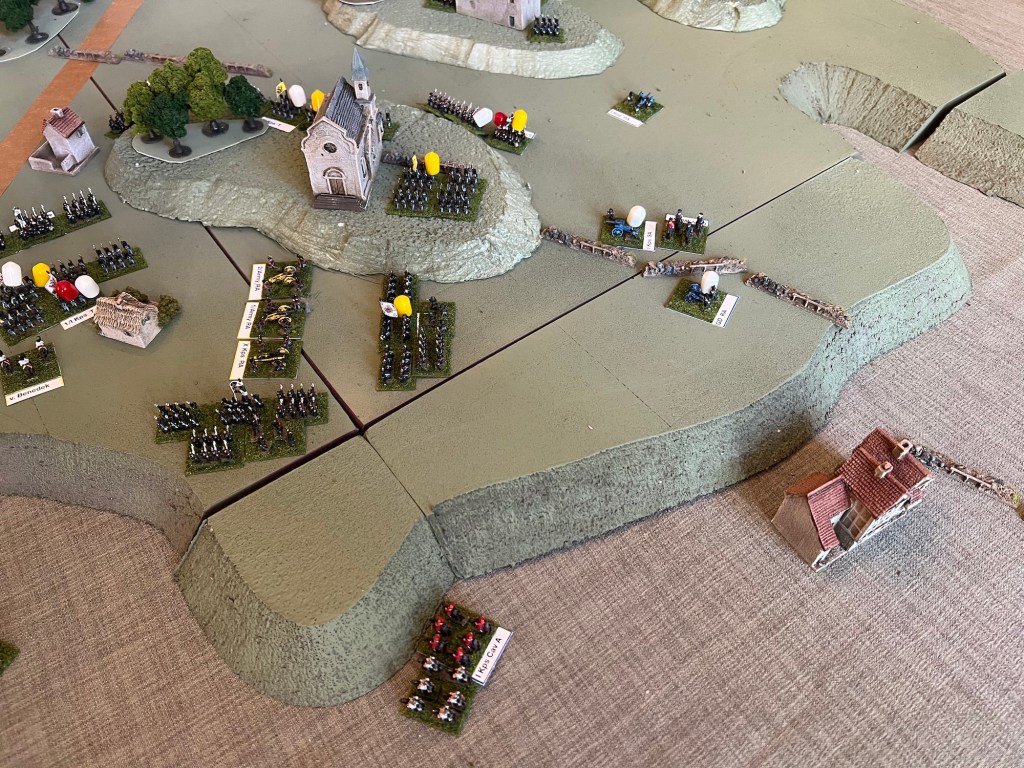
The heroes of the army, Brigades Appiano & Benedek continue to hold the line to the west, but the remaining brigades were rapidly falling back. It was unlikely that the retreating Austrian center could move fast enough to escape the rapidly closing net.
The Saxons too were having difficulty breaking off. The 2nd Division could only wheel to protect its flank, forcing the 1st Division to remain in place. With the Elbe Cavalry to their rear, the Saxons would need to join the Austrian retreat along the Chlum-Königgrätz road.
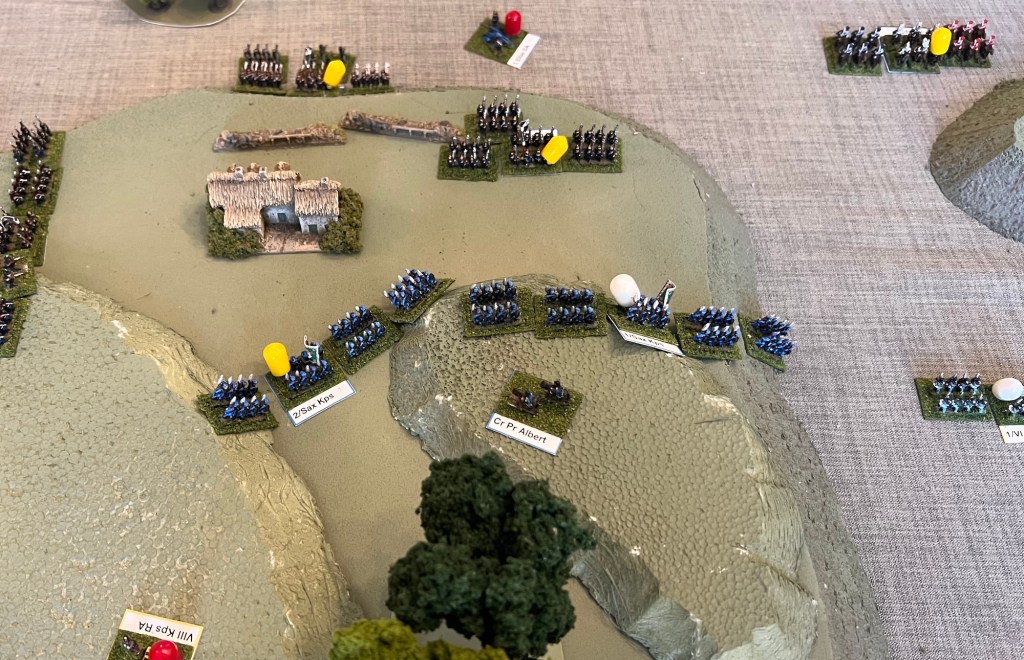
I called the game at 1800.
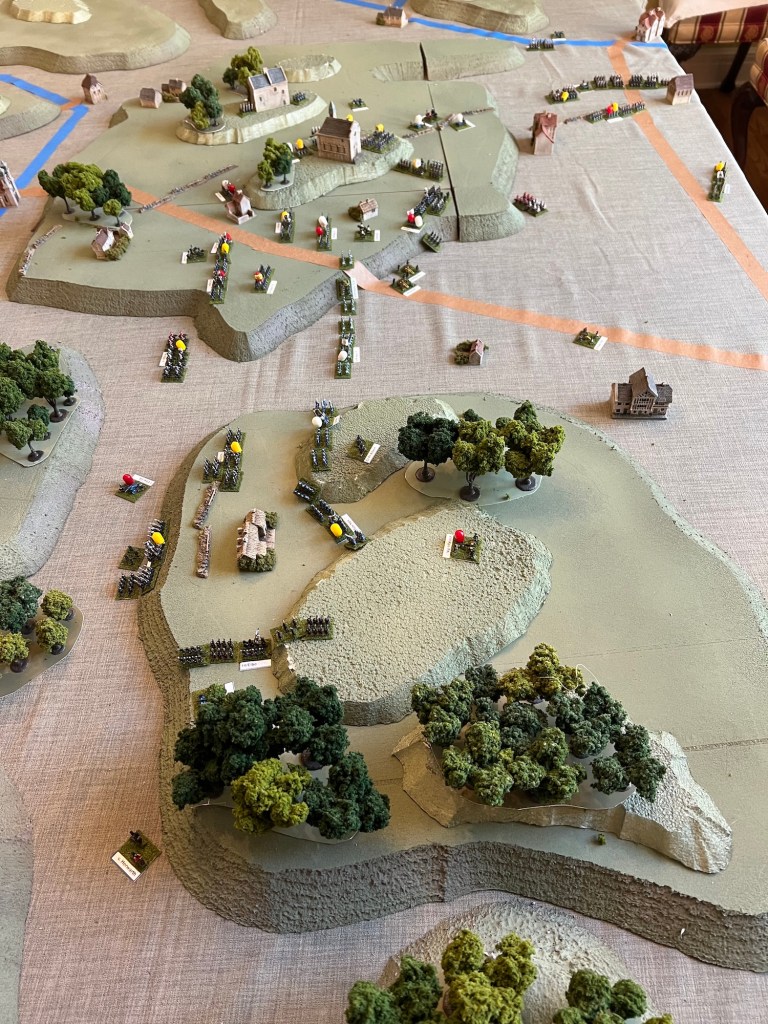
Austrian losses: 30 inf stands, 3 cav stands, and 5 art stands. In addition 4 inf, 3 cav and 1 art exited the table battle.
Prussians: 18 inf stands, 3 cav stands, 2 art stands.
This is a difficult battle for the Austrians to win. Note I am talking about the battle and not the scenario. I completely ignored the objectives until what I thought was the last turn. If I had used the Elbe Cavalry to turn the Saxon position (the better military move) instead of dashing to Stěžer, the game would have been a draw. If the Guards had lost Nedělišt as well, it would have been an Austrian win. But that would have been unsatisfying for me as that win was only because the die rolls that prevented the Prussians from fully developing their concentric march to the sound of the guns. My Austrians had nothing to do with making those problems happen.
Overall the Bloody Big Battles rules are a joy to play. They do allow gamers to fight those large historical battles in a reasonable amount of time and table space. I do have some issues with the rules, and I will discuss those over time.


 The Manchurian War
Leave a reply to jwsleser Cancel reply