As one can tell from this blog, I have a very strong interest in the Russo-Japanese War. I have wanted to get more focused on that period of history, but also have other interests in contention. I have been working on rules for the military campaign, but my recent experience with GQ3 indicated that a good rule set for the naval campaign was possible. So I have taken a bit of time to see what is possible.
The following battle was the first test of my modifications to the GQ3 naval rules for the RJW. I purchase a copy of Fleet Action Imminent (FAI) in the hope that the rules included the older ships from the RJW that were still in-service. This I discovered was very hit or miss, but mostly miss as FAI is more focused on the North Sea and the Adriatic. The French and Japanese fleets were not included, and ships on foreign service from the UK, German and Russian navies were mainly omitted (e.g. Emden was included, but not its enemies such as Askold, Jemtchug, or the aforementioned French and Japanese). There were several useful Russian logs, so it gave me a little bit to work with.
Several of the modifications I used have been extensively tested as mods to the WW2 version of the GQ3 rules that we use in our local group. Other modifications are new to reflect the reality of the nature of naval warfare in 1904-1905. More testing in certainly required but this initial foray succeeded better than I had hoped. I was so busy capturing the events during the battle that I forgot to to place the hits and shell splashes for the pictures until late in the battle.
This is also my first foray using 1:6000 model ships. The models are from Figurehead and they offer a complete line of Russian and Japanese ships for the war. I was impressed by the detail, but found they aren’t easy to paint. Unlike later warships that are fairly streamlined in design with central turrets and clean sides, these earlier ships have guns everywhere and the hulls have all sorts of shapes and things stuck on them. Trying to paint a straight line was a challenge, with something always protruding in the way. For the first time in my experience with naval wargaming, the scale called to me to add funnel smoke. Given all the ships was coal burners, I felt adding funnel smoke was the right thing to do. It does obscure some of the detail of the models, but the overall effect for me is positive and right for the period.
This was a refight of the Battle off Ulsan on 14 August 1904. The Russians had three armored cruisers and the Japanese had four armored cruisers with two protected cruisers joining later. The Japanese cruisers found themselves between the Russian cruisers and their base at Vladivostok. The Russian ships need to escape to the north while the Japanese ships need to stop them.
The scenario starts at 0500 on 14 August. The ships are 18,000k apart with both squadrons at 10kts. The Japanese are on a basic course of 90º (E) while the Russians are on a course of 60º (NE). Max range for the 8” main batteries is 8k. The 6” secondary batteries have a range of 6k. The Idzumo is leading the Japanese line, with Adzumo, Tokiwa and Iwate following in that order. Rossiya is leading the Russian line, with Gromoboi and Rurik following. The Japanese broadside is sixteen 8” guns and twenty-eight 6” guns. The Russian broadside is six 8” guns and twenty-five 6” guns.
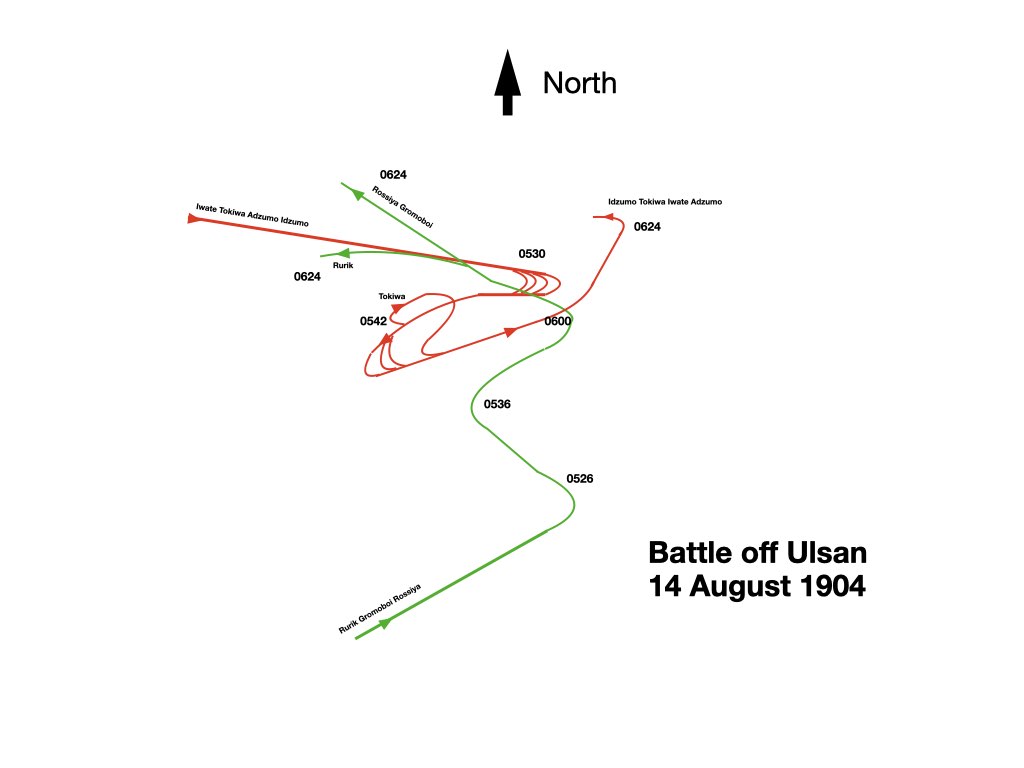
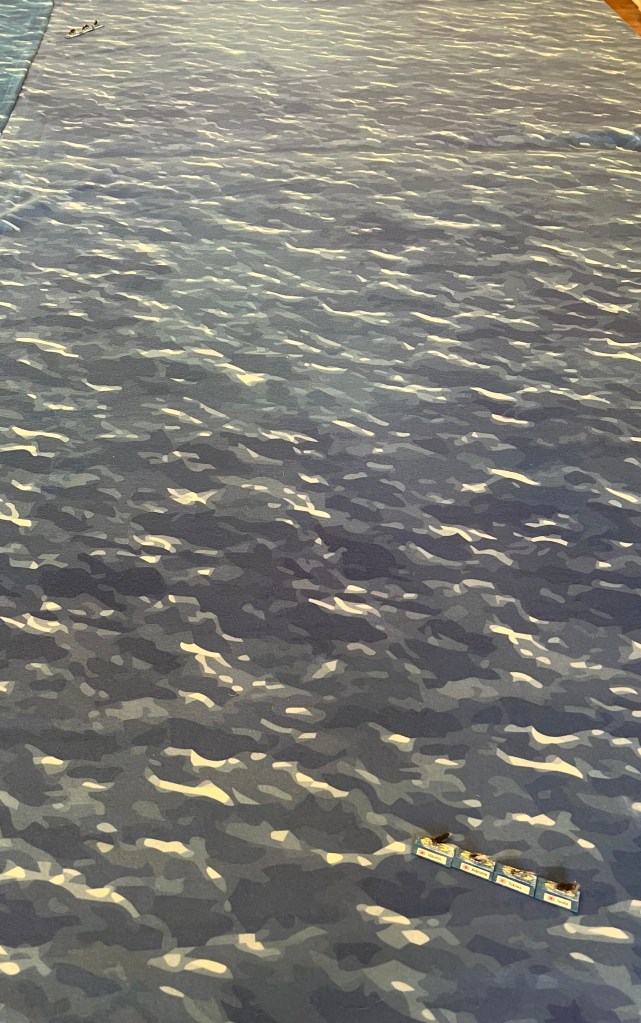
Both sides maintained their present course until 0524. At a range of 9.5k, the Russian Squadron turned 10 points in succession to port, taking up a course of ~300º (NW). Six minutes later after detecting the Russian turn, the Japanese squadron executed a simultaneous 16 point turn to starboard, both closing the range and reversing the order of the Japanese ships. The Japanese squadron had worked up to 21kts, the Russians to the maximum of Rurik’s 18kts.
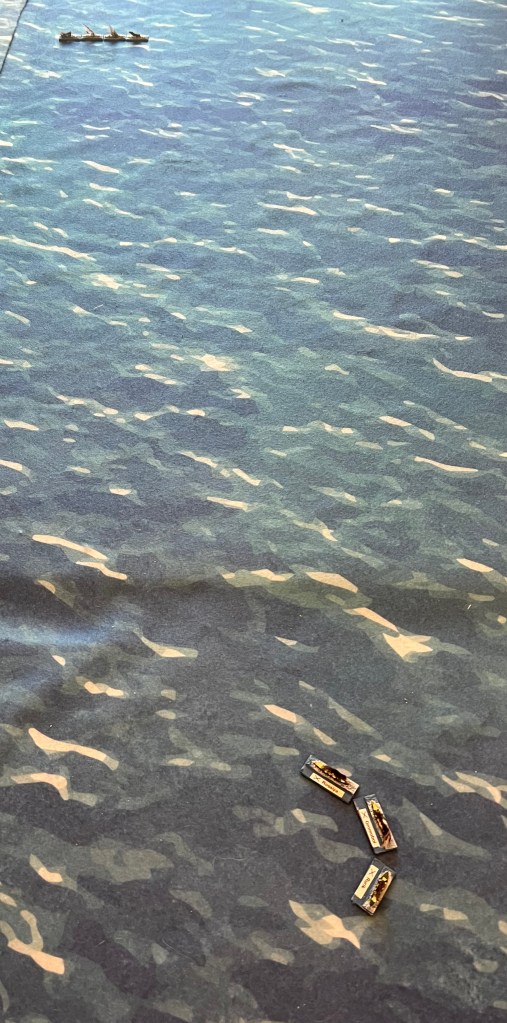
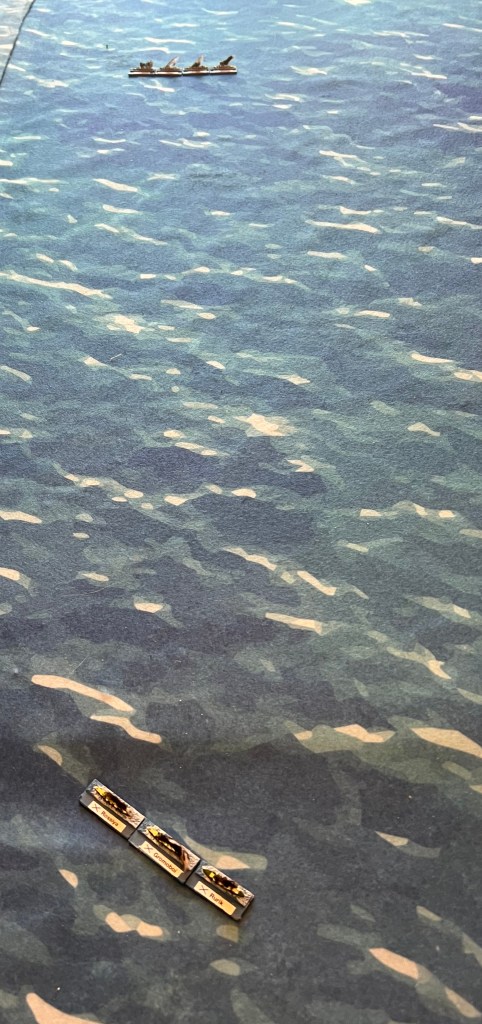
Both sides opened fire at a range of 7.6k-8k. Iwate scored one hit on Rossiya, taking out a tertiary gun and starting a fire. The Russians didn’t score any hits.
By 0536 that range had dropped to under 6k, so both sides began firing their 6” batteries as well. Iwate score one 6” on Rossiya, while Tokiwa added two more. Rossiya hit Iwate in return with a 6” hit, and Gromoboi hit Tokiwa within 6” as well. Rossiya took one hull hit (no penetration so 1/2 each, a mod. separates hull hits from underwater hull hits) while the third round was a dud. Iwate lost a searchlight and had a fire. Tokiwa’s hit was more serious with a hit to the steering compartment. This cause a 1/2 underwater hull hit and the rudder jammed to starboard. Rossiya was able to put out the fire.
At 0542 the Japanese squadron continued ahead, with Tokiwa swinging out of line to starboard and Iwate mastered the fire. At the same time the Russian squadron executed a 16 point turn in succession to starboard. Range was between 3.8k to 4k. Idzumo hit Rossiya with an 8” shell, while Tokiwa at 4.6k hit Gromoboi with a 6” shell. Rossiya and Bromoboi both missed, but Rurik tagged Iwate with an 8” round that penetrated the armor and caused a hull hit.
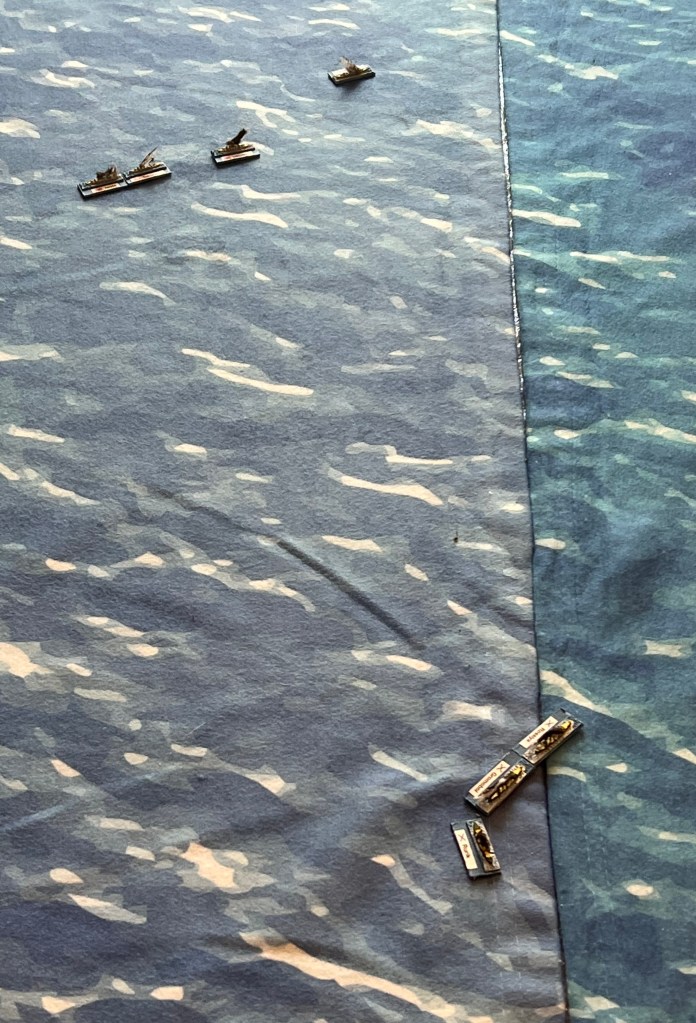
The Japanese squadron reacted to the Russian turn by executing its own simultaneous 16 point turn to port. Both sides continued to close with the range down to 2.8k-3.5k by 0548. Tokiwa repaired her steering gear and turned to rejoin the squadron. Tokiwa gunnery officer continued to score hits, hitting Gromoboi with one 8” and two 6” shells. Iwate also hit Rurik with one 8” and one 6”. Gromoboi took the 8” in the forward funnel and two 6” in the hull, but neither penetrated (a total of one hull hit). The most serious hit was on Rurik, losing one portside 8” gun. Only Gromoboi was able to hit back, scoring an 8” hit on Tokiwa that was a dud.
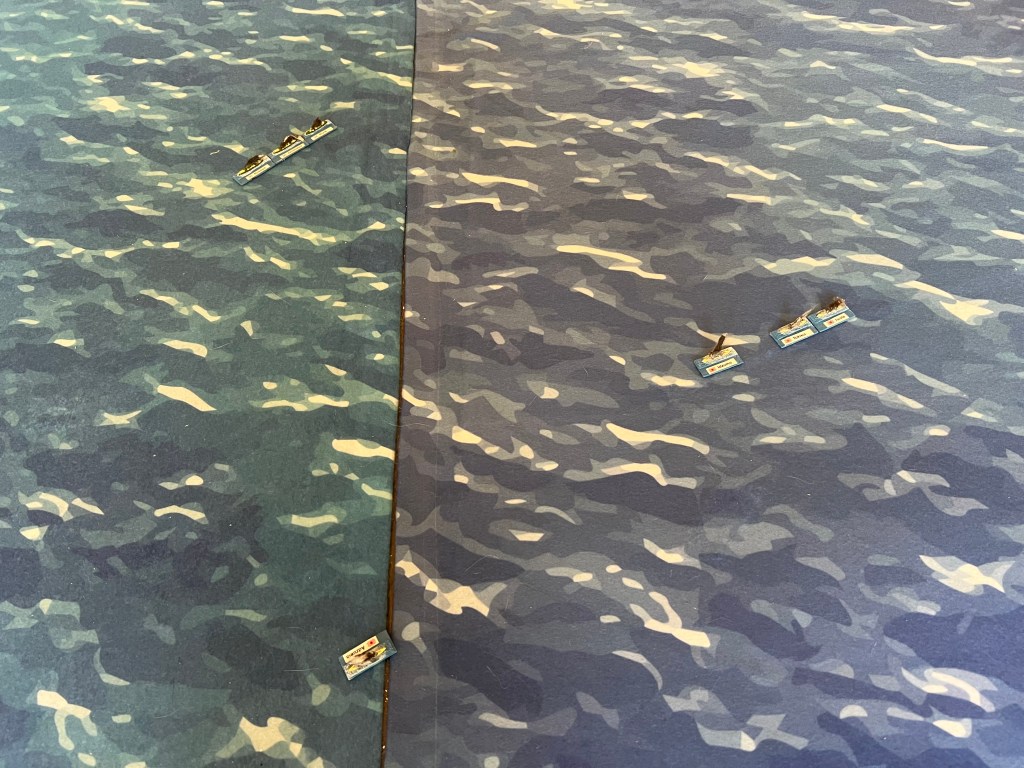
With both squadrons on parallel courses, the Russian ships were slightly ahead of the Japanese squadron. The Russians edged closer to a course of 30º hoping to cut in-front of the Japanese line. The Japanese edge of 3 knots over the Russians would make this move risky but it was the Russians best option at this point in the battle. Range continued to close, getting down close to 2k. At this distance, the 6” batteries on both sides could do serious damage. It was the Japanese gunners that leveraged the close range. Idzumo hit Rossiya with one 8” and three 6” shells with Adzumo adding another 6” hit. Tokiwa hit Gromoboi with two 8” and two 6” hits, while Iwate scored four 6” hits on Rurik. Luck favored the Russians at this point with four of the shells being duds. Still Rossiya took a hull hit and a funnel, Gromoboi took a hull hit, but Rurik suffered with three funnel hits, and lost its other portside 8” and a tertiary gun plus a fire. One more funnel hit on Rurik and her boilers would loose effective draught and her speed would drop. Given she was the slowest ship in the battle, this could be fatal. In return Rossiya only hit Idzumo with two 6” shells (both tertiary hits and fires), and Gromoboi scored on Tokiwa with one 6” (damaging a 6” gun).
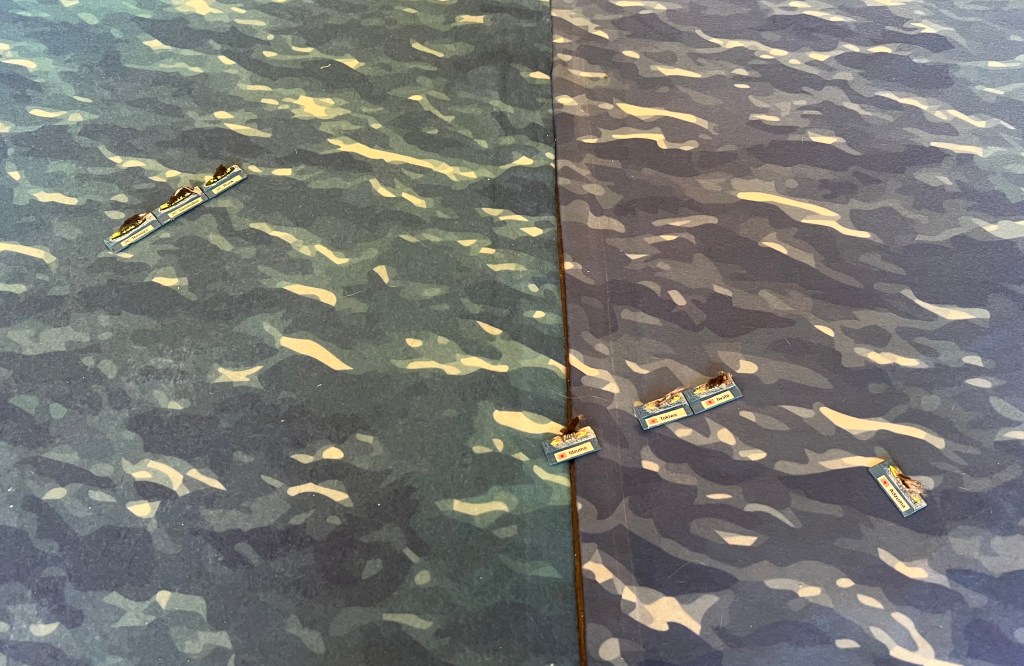
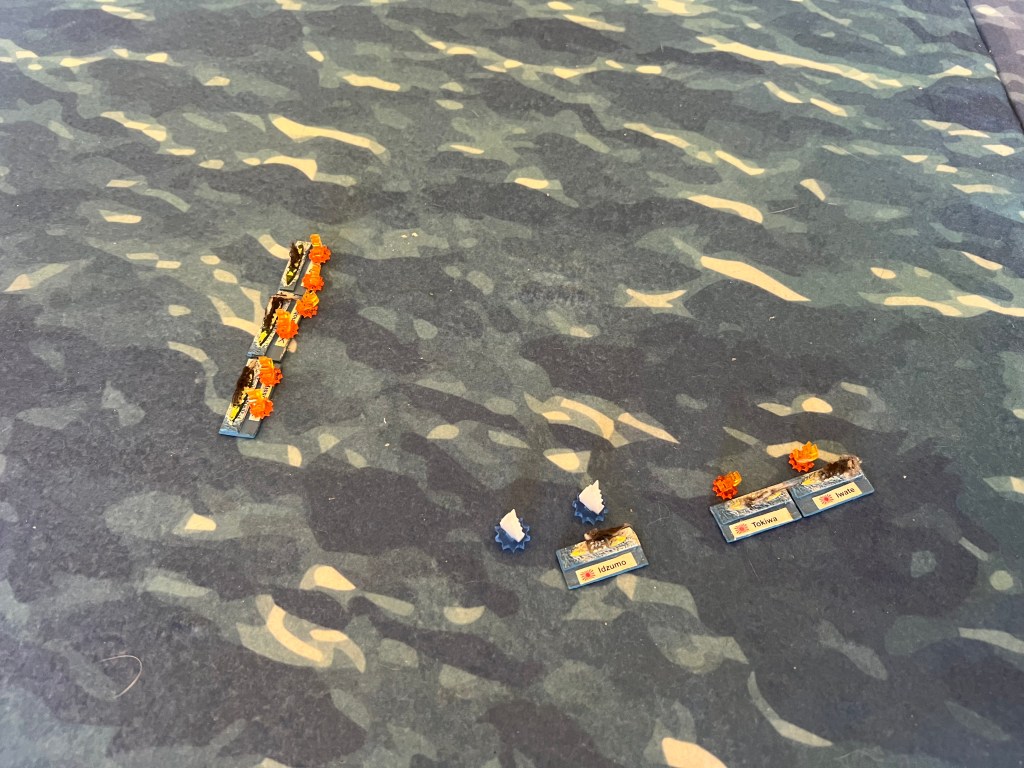
With both sides rapidly closing by 0600, it became clear that the two squadrons would cross each other. Both admirals came to the same conclusion that the other squadron would turn away, hence both their current course. As Adzumo hadn’t rejoined the squadron and Idzumo hadn’t slowed down, a gap remained between Idzumo and Tokiwa. It was through this gap that Rossiya sailed through. However Rossiya had to swerve to starboard avoid Tokiwa, that ship swerveing to port (collision die roll).
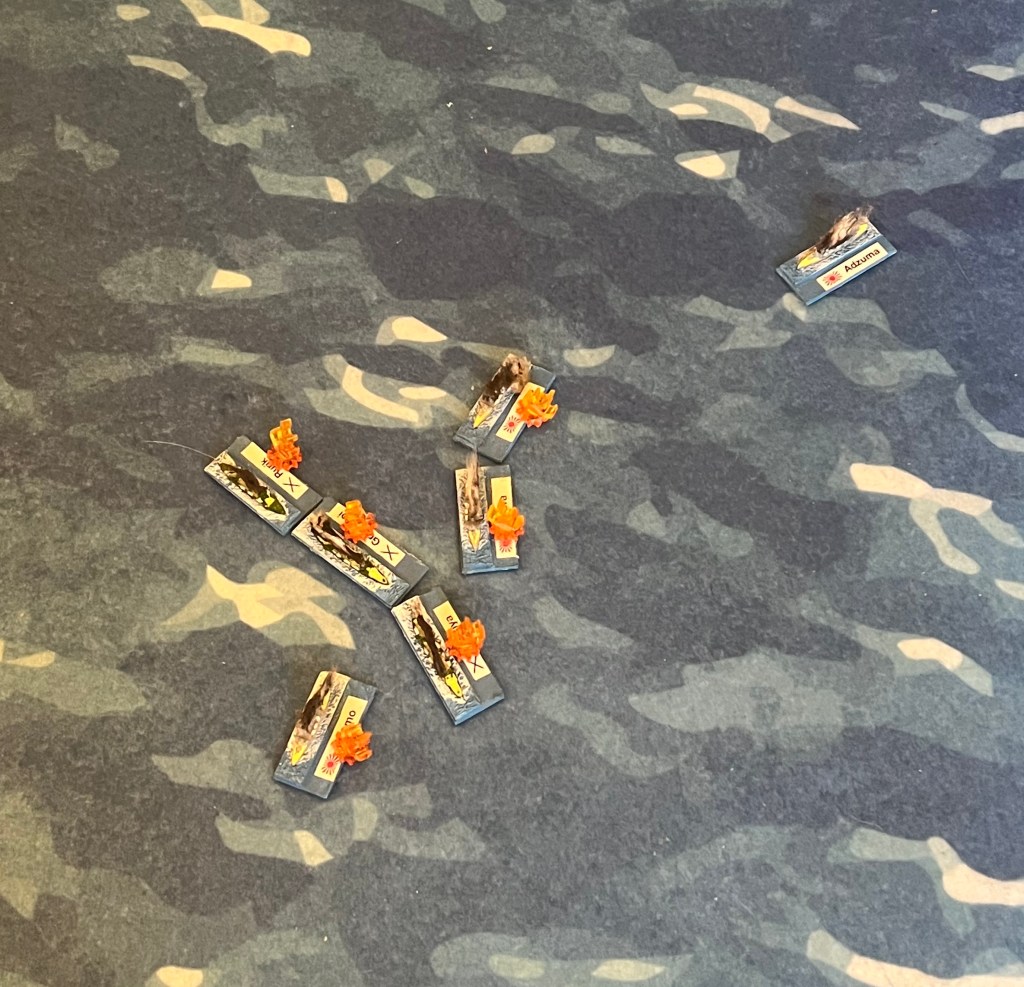
The gunners on both sides took advantage of the close range. Rossiya hit Idzumo with four 6” shells and Tokiwa with one 6” shell. Gromoboi hit Idzumo with an additional 6” shell and three 6” hits on Tokiwa. Rurik starboard 8” guns could now bear on Idzumo and she scored one hit as well as three 6” hits. Rurik’s portside 6” battery adding four 6” hits on Iwate. In return, Rossiya took two more 6” hits, Gromoboi took two 8” hits, and Rurik was pounded with two 8” and eight 6” hits. Rossiya lost an 8” gun and a funnel hit. Gromoboi lost a 6” and a tertiary gun, but Rurik suffered. She took three more funnel hits, reducing her speed to 14kts. Worst she also took a boiler room hit, reducing her speed further to 11kts and a hull hit. In return, Tokiwa took two hull hits and lost a tertiary gun and searchlight. Iwate took a 6” hit on her forward turret, which at this this range penetrated and took out the turret. Two shells penetrated her hull. It was the critical hit on Idzumo that gave the Russians a chance. An 8” shell smashed into her steering compartment and the rudder became locked straight ahead. Four hull hits and a searchlight followed.
The Russian admiral saw the serious damage on Rurik and made a decision (a die roll). He rang up full speed (20kts) and steered straight ahead. Gromoboi followed with Rurik doing her best but falling behind. For the Japanese the situation was bad. As Idzumo was steaming straight ahead, the other ships followed. The Japanese admiral attempted to signal the other ships to breakaway and follow the Russians but the signals failed to get through (another die roll). Both Idzumo and Rurik failed their repair rolls. The range was opening as the japanese ships followed their crippled leader. Tokiwa hit Rossiya with a 6” shell but only damaged a searchlight and started a fire. The other three ships missed. The Russian gunnery was better with one 8’ and two 6” hits on Idzumo, one 6” on Tokiwa, and one 8” and one 6” on Adzumo. Both Idzumo and Adzumo took a hull hit, while Adzumo also lost its forward main gun turret to an 8” shell that penetrated.
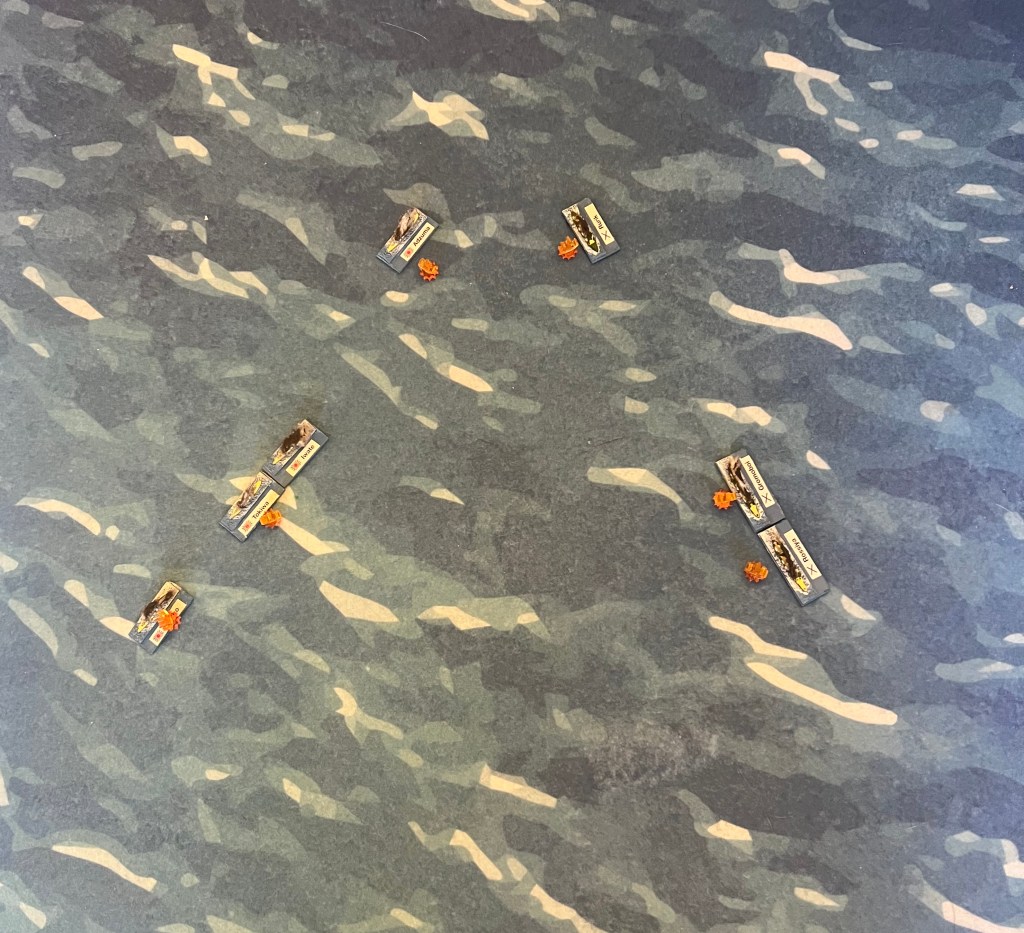
Range continued to open as the Japanese admiral again failed to successfully signal his ships. Idzumo failed to repair the steering gear while Rurik was able to get her boiler room back online. This allowed her to increase speed back up to 14kts. With this, the Russian admiral was able to signal Rurik to steer due west while the other two cruisers continued NW at 20 kts. At 7.9k Idzumo managed to get an 8” hit on one of Rossiya funnels but it wasn’t enough to slow the big cruiser down. All the other ships missed their targets.
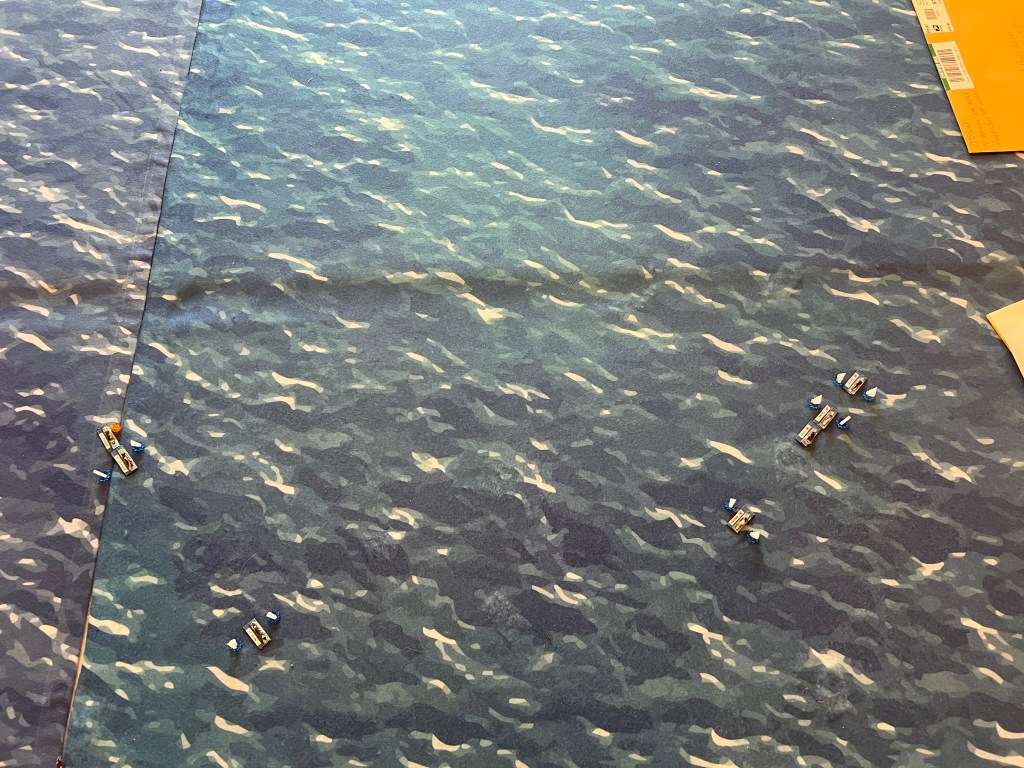
At 0618 Idzumo was able to repair its steering gear and led the Japanese squadron around to nearly a due west course. The two big Russian cruisers were out of range and a long stern chase was in the offing. With two of the Japanese squadron’s four forward 8” turrets out of action, such a chase didn’t look promising (the Japanese didn’t know that Rossiya was also down one 8” gun). Rurik was making off to the west and was likely easy prey. If Idzumo took an additional three hull hits, any hull hits after that would be underwater hits. The decision was to go after Rurik (a die roll).
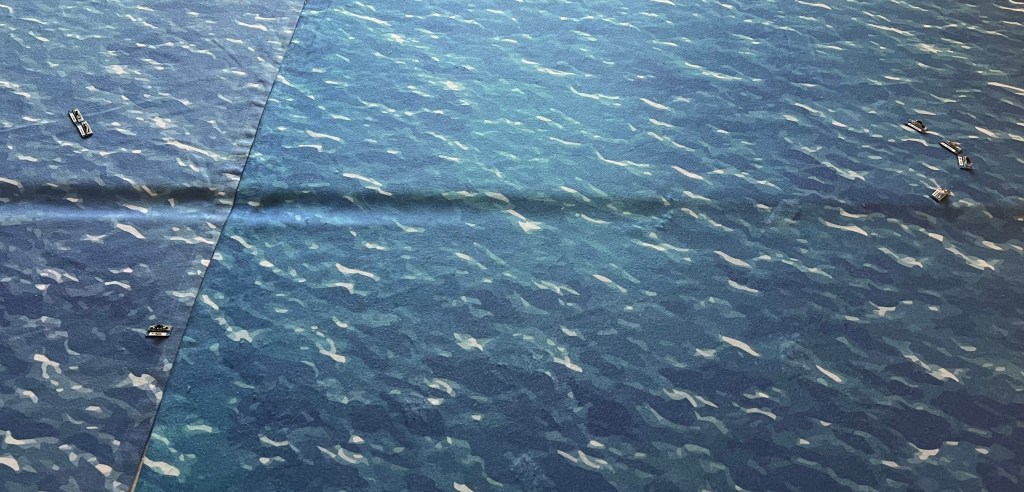
I called the game at this point. Rurik was unlikely to escape but would put up a good fight.
Hits on:
Rossiya 4 – 8” 10 – 6” Idzumo 2 – 8” 12 – 6”
Gromoboi 5 – 8” 5 – 6” Adzumo 2 – 8” 1 – 6”
Rurik 3 – 8” 9 – 6” Tokiwa 1 – 8” 7 – 6”
Iwate 2 – 8” 4 – 6”
Russians scored 7 – 8” and 24 – 6” hits
Japanese scored 12 – 8” and 24 – 6” hits
I allowed the 6” to use the rapid fire die rolls for hits under 4k, but 11 and 12 were only one hit each. No one rolled a 3 when it was three hits. I didn’t expect the range to close enough for the 4.7” guns to come into action, but it did. I hadn’t work out the details for those guns so the number of hits was a little lower than it could have been. The number of hits are generally inline with the historical battle.
A challenge were the ship logs. Given 4.7” and 4” were used against cruisers and battleships, the logs need to reflect those individual weapons. This will requires the logs to accommodate three different sized batteries and a general number for anti-torpedo boat/destroyer action. As secondaries were mainly installed as individual gun mounts, I had to increase the length of the ship logs to place those weapons. Adding the 4.7” and 4” will likely require the height of the logs to increase. The height was already increased for the underwater and funnel tracking, but there are possible efficiencies from my first builds.
I still need to shape the torpedo rules. The threat of the torpedo was real, but their actual effectiveness was almost nil. I feel some creative rule writing is needed to have player react correctly to the threat without making the torpedo attacks themselves more effective than they historically were.
An internal debate is whether to use trial speeds for ship or actual speeds during the war. The information for the latter is not complete, but offers some interesting possibilities for tactics. I am currently testing using trial speeds, but that will likely change.
I liked they way the rules worked so will continued to tinker on them. Ship logs for the battleships are next, with a Yellow Sea-ish test the current plan.


 The Manchurian War
Leave a comment